Writing

There Something About the Lights in December

I'm a lover of early Christmas decorations. 

I know, I know. I'm one of those people

Whenever people talk about the Christmas Creep (that delightful moment when Halloween ends and suddenly, everything in stores is replaced with Christmas stuff and it's happening earlier and earlier and faster and faster every year, hence, "the Creep"), they look to me with an expectation of solidarity. "I hate how once Halloween is over, bam! It's Christmas!" Then the piercing look. I gulp. 

"I actually love early Christmas. The longer it lasts, the better," I reply, making a mental note to not invite them to my house until after Thanksgiving. 

Why, you ask? 

I already have my Christmas tree up. In fact, I've had it up since the day after Halloween. 

What can I say? I just get so excited. I just want everything to be peppermint, to be red-and-white striped. I want to wear fair isle sweaters and beanies and snow boots. I want red cups at Starbucks and Christmas music on the radio. I love it. I always have. 

Thursday night, I left work to meet my sister-in-law, Amy. We walked and talked and ate frozen yogurt. After I drove her home, it was starting to get dark (5pm, still early) and I realized that I love that feeling. Those first nights of early evening, when the world seems to turn the lights out at exactly 5:30. The headlights and the neon signs of shopping centers and the stars shining like Christmas lights. I love those early days: it feels magical and crisp and happy. I remember driving home from school or events with my mom, sitting in the front seat and watching the lights shine past me. It reminds me of a lot of things, but mostly, it reminds me of my family and home and being blissfully happy. 

So when it comes to hate towards the Christmas Creep, I have to be perfectly honest: you won't find kinship with me. 

NaNoWriMo: That Pesky, Persistent Editor

Current word count: 12,031

Current word count: 12,031

Last year at this time, I think I was a terrifying 3 days behind on NaNoWriMo. I distinctly remember one weekend spending every free moment frantically writing -- that's when the "word vomit" happens, the divergence from plot or the random additions of subplots that don't make sense. I think I went a whole week without working on NaNoWrimo. But I valiantly struck back and kept with it and wrote potentially the worst novel on the face of the planet as a result. 

This year, it's like everything has flip-flopped: I'm at 12,031 words, which is about two days ahead of schedule. Two days. I could not write for two days and not fall behind, not feel like I'm trying to scrabble up on a mountain made of virtual text. 

In the past five days, I've written the beginning of a novel that, ok, might not win any awards, but it's something I might read (if it was $0.99 on my Kindle). What's the difference here? 

Last year, I was in a very different state emotionally. I was incredibly critical about myself and I believe I let my inner editor get the best of me. The best, and weirdest, part of NaNoWriMo is that you really just have to hide your inner editor away for an entire month. I mean, 30 days without listening to the voice in your head that says, "This sentence is bad" or "you should think of a better metaphor." Maybe it's good advice, Inner Editor, but I have 50,000 words to write and I don't have time. Shutting that little voice up is the only way to survive and make it through.

Last year, I wrote and struggled the entire time, because that inner editor wasn't just talking about my horrible novel (and it was bad, guys, have I mentioned?) -- it was talking about me. "That's a horrible sentence" turned into "you're a horrible writer." Who wants to listen to that everyday? Eventually, I stuffed it down, but it was always there, poisoning my writing, poisoning my thoughts and behavior. 

This year, I'm mentally and emotionally in a better place. Suffice to say, I don't hate my life and while my inner editor still assaults me with useless feedback ("you're legs look like stuffed sausages in those boots!"), I'm more able to ignore it and move on with my life.

Writing is easier too. I worried that my day job as a writer would make writing difficult -- writing 6-8 hours a day and then writing more sounds pretty exhausting. But I've found the opposite. After 6-8 hours of writing blogs and copy and more, I actually find I'm energized to work on NaNoWriMo just because it's different. Now that I'm not miserable all the time, having energy to write additionally in the evening is just kind of how it is.

As I continue on NaNoWriMo, I'm sure I'll have more observations on what makes it easier or more difficult. Fighting down the urge to edit, to change, to start over and be "perfect" is a big step towards actually completing NaNoWriMo -- and ultimately, a step towards completing a novel that ends up being at least decent. 

In Taylor Swift v. Spotify, the Fans Are the Losers

The same day Taylor Swift announced the 1989 World Tour, she pulled her entire catalog from Spotify. 

The same day Taylor Swift announced the 1989 World Tour, she pulled her entire catalog from Spotify. 

I'll be the first to admit that I didn't like Taylor Swift for a long time. The first time I heard her first album, I was 18, was about to graduate high school, and worked at a pizza place in my small hometown; a coworker, who loved country music, put Taylor's first album on repeat for an entire slow Saturday afternoon. I listened to Taylor Swift sing "Teardrops on My Guitar" about 27 times that day. When, a week later, my best friend Holly asked me if I'd heard this amazing song called "Tim McGraw" by a girl named Taylor Swift, I nearly smacked the CD out of her hands. 

I was mostly indifferent through the next few years of Taylor Swift's career. As she got more popular -- and the subjects of her songs were dissected and spread across blogs and Twitter -- I remained vaguely disinterested. Occasionally, she'd get me through an ear worm or two, but I was otherwise bored by her. I mean, was there anything more annoying than "Love Story"?  

Say you’ll remember me
Standing in a nice dress, staring at the sunset, babe
Red lips and rosy cheeks
Say you’ll see me again even if it’s just pretend
— "Wildest Dreams," Taylor Swift, 1989

It was easy to ignore Taylor for a while. She existed on my periphery. I was acutely aware of her, in the same way I'm acutely aware of Selena Gomez and other young starlets. Then, Red came out and things kinda changed. I loved "22" (honestly, who doesn't love that song)... but it wasn't good enough to get me to the buy the album.

At the time of Red, I was deep into fashion blogging and I felt pretty bitter that Taylor was dressing in a way that harkened to "my people" (other fashion bloggers). I felt like our style had been appropriated after her country days. I didn't like it. It was kind of selfish and babyish, but hey, it's true. I didn't like her because she wore twee little dresses and I wore twee little dresses but obviously I did it first. 

I went back to ignoring most things Taylor Swift did.

However, a few months ago, when "Shake it Off" came out, I honestly couldn't stop listening to it. We've all probably seen the SNL skit by now, but it really was Taylor Swift vertigo. I found myself unable to not like it. Ok, love it. I loved it. It was an earworm. It was dance-y. It was great for singing in the car on the way to work. 

I bought 1989 quietly while home sick from work, but then found myself listening to it nonstop. In the bathtub. Cooking dinner. On the way to Target with my husband. At work. At the gym. Everywhere. Stunned. I'd never listened to a Taylor Swift album on repeat -- not since that fateful day at the pizza place when I was 18. 

However, my enthusiasm for 1989 came to a grinding halt yesterday morning when I discovered that Taylor had removed all of her music from Spotify. 

Now, Taylor has been pretty down on services like Spotify in the past. She says that, essentially, all art is beautiful and we should pay for all art. Which, okay, sure. I'm all for artists being paid. But, as I tweeted yesterday morning, I think there is a huge difference between a pop star like Taylor Swift and, say, an independent musician. Spotify can be a great service for independent acts, because it can make us aware of music we wouldn't otherwise be able to find. If I really like an album on Spotify, I usually buy it. It's a great way to know if I'll actually like something before I buy it. 

1989 is already breaking records. And yet, Taylor Swift worries that a service like Spotify will hurt her record sales. Really, Taylor? Really? 

Taylor probably thinks she's sticking up for artists and the music industry -- she's just a good person like that -- but really, she's just hurting her fans and people who would otherwise support her music. Taylor's album is already selling insane numbers, so the idea that a service like Spotify would hurt her album sales is absolutely ludicrous and, to be completely honest, stinks of nothing but greed. We know Taylor isn't a struggling artist; she's already richer than basically everyone I know and have ever met combined

Mostly, this all reminds me of the reason why I could never get on the Taylor train before "Shake it Off". Something about Taylor is so good, so squeaky clean -- and yet, she's always the victim. In every song, in every interview, it's the mean girl saying something to her. The boy breaks her heart. She's the victim. She's left behind. She's the sad one with the ballad, the broken heart, the past being bullied. Even "Shake It Off" suggests a victimhood and a dismissiveness that is kind of repulsive if you think about it too much. I think you're a good person, Taylor, but no one is that good

And, once again, I feel like Taylor is trying to paint herself as the victim: big, bad Spotify robbing her of album sales. But really, whose bigger here? Taylor Swift, who has sold millions and millions of albums, or Spotify, a service that charges $5 or $10

I don't know, Taylor. All I know is: in the span of a month, Taylor Swift managed to convert me to being a big fan... and now, she's kind of lost me. 

The Power of Decisions

According to Time, the average person makes up to 5,000 decisions per day. 

And for some people, that number is probably even higher. When you think about it, each action we take is a decision: going to bed at 10pm or continuing to watch a movie until midnight; hitting snooze or turning your alarm off (and getting out of bed); making coffee, taking a shower, putting on make up, getting dressed. Teeny tiny decisions every day. We decide what to eat for breakfast, when to leave for work. At work, we decide whether to schedule or postpone meetings, whether or not to email a client back or wait. Thousands upon thousands of decisions, sometimes lasting only a fraction of a second -- but some last even longer. 

There is nothing quite like the agonizing argument I have with myself every weekday evening. I should work out, I text my husband, but in the back of my mind, I whine: But I don't waaaant to. You should -- it's good for you. You ate a bagel for lunch. But I am so tired. I barely see Danny... Back and forth, until I decide one way or another. I decide which route to take home. I decide what to make for dinner. I decide... I decide... I decide. 

And at a certain point, we just aren't able to make decisions anymore. That's kind of the funny thing: the more decisions we force ourselves to make in a day, the more difficult it is for us to make those decisions -- which means, it's more difficult for us to be creative. To be creative -- that is, to create, to write or draw or scrapbook or anything -- we need to be able to make decisions that impact what we're doing. Should we use this word or that one? Should a character be named Angela or Angelica? So if we've used all of our decisions on the minutiae of our lives -- whether or not to work out, raspberry or strawberry smoothie, nonfat creamer or milk in our coffee -- then we have a harder time actually being creative people. 

For people who are terrible at making decisions, it's even worse. 

I've always agonized over decisions. Sometimes, I fantasize about how my life would be different based on all the decisions I've made in my life. When I was younger (that is, under about 13), I would often wonder if the decisions I often agonized over -- chocolate or vanilla ice cream, going to Portland for my birthday or the coast -- really had an impact over my life. Would I have more friends if I was a vanilla ice cream person? (I am decidedly a chocolate ice cream person -- and I have since found that people who favor vanilla tend to be more personable and outgoing than me, so perhaps I'm onto something there.) 

I like to make decisions alone, but I also secretly like to have people make suggestions to me. I always text my husband and my mom when a big decisions comes up -- and while both of them usually reply, "I don't know, you should decide" or something to take effect, I kind of always want them to tell me what to do. I'll always frame it as "well, I decided this" -- but really, I like to leave the hard stuff up to other people. I often wonder if I have a hard time making big decisions -- whether or not to be short term disability insurance, whether I should plan for a pregnancy in 2015 or 2016, how much money I should save every month for property taxes and insurance -- because I spend so much time agonizing over the little things, like whether to buy lunch that day or if I should work out. 


There is one thing I know for absolutely sure: 

When I spend a lot of time making decisions -- whether it's little things or big things -- I have a harder time getting work done, being creative, and writing. I don't write in my journal; I'll fall behind on creative projects; I'll put off scrapbooking, my favorite hobby. 

So what does that mean for me? If I intend to live a more creative life -- which is a goal I have for myself -- what can I do to keep myself from taking away all of my decision-making power? 

One of the most important things I need to do is have a routine. I used to be one of those people that did the same things at the same time of day, no matter what. Throughout college, I got up at the same time, worked out at the same time, ate at the same time, went to sleep at the same time. I had a routine I did when I woke up, when I went to bed, when I did my homework. I was a human of routine. The farther I've gotten from school, the more I've gone rogue -- and in that time, I've spent a lot of time making stupid decisions. (Should I brush my teeth now or later? Just kidding, I'll spend 20 minutes sitting on the living room floor picking out a movie -- the HobbitVenture Bros, or Blade 2?) 

Right now, I'm working on a routine. Planning outfits, planning meals, planning workouts. Not having any excuses. Not allowing myself to change the decision I've already made. If I've already decided to wear jeggings and a sweater tomorrow to work, if I've already decided to pack my gym bag and put it in the car and work out after work, if I've already decided to make lasagna for dinner, then I've already removed the burden of those decisions. I've created a somewhat streamlined day for myself already. But I can narrow it down even further. I can just know I'll wake up, shower, put on make up, make coffee, pack up my car, and leave. No deviations -- I've already decided. If I know that, I'll be more prepared to be productive at work, to make creative decisions, to get home from a good workout and write. 

I want to be a more creative person and part of working towards that goal means altering the behavior I've allowed myself to get away with out of pure laziness. It's time to get things in order. It's time to get my decisions under control. 

NaNoWriMo 2014

nanowrimo.jpg

I've completed NaNoWriMo three times. 

I first learned about NaNoWriMo my freshman year of college, but I didn't attempt it until I was a junior. I think this is partly because I was too shy of my writing until I was over the age of 21 and because I always had intensely grandiose plans for novels that never came to fruition (but I was more competent in terms of writing after my sophomore year, so the plans seemed in line with my abilities). 


The first year I completed NaNoWriMo, I wrote a tepid novel called Cut that focused around a girl named Monica. I don't even remember the plot and my feelings of intense embarassment for 21-year-old me prevent me from opening the file on my computer. It just sits there, an embarrassing reminder of everything stupid I've ever done. 

The second year, I was prepared and ready. I wrote a novel called Succotash (a title I stole from our literary magazine name suggestions, that I liked and was mad we didn't choose). Succotash was about a girl named Erin who attended college in Idaho and hated her life. There were several characters based on my favorite musicians (deeply embarrassing) and other characters based on people I knew (including my future husband). The novel is boring and has no plot, consisting of mostly vignette-length character studies repeated over and over again. If I'm good at anything, I am amazing at character studies. I've reread this novel a few times and while it pretty much sucks, it's not horrible and I could probably dig out some good passages for future writing if I had the motivation. 


I skipped a few years after college. I vaguely remember starting novels, but not finishing them. In 2011, my grandfather died in November and I don't remember writing anything for a long time after that. The next year, I was working full-time and couldn't make time in-between my work day and crushing depression. 


Last year, however, I completed NaNoWriMo for the third time. I wrote a novel called Runner's High, that is as silly and stupid as it sounds. I wanted to write a typical crime/mystery novel, but I ended up circling the drain about two weeks in. My idea was simple enough -- a competitive runner witnesses a murder in the woods and helps police track down the killer -- but my lack of research, combined with how bored I became with my main character named freaking Aurora (why, Michelle, why!?), led me to, again, write bored character studies over and over again. The most interesting part of the novel became the fact that the murder victim had an identical twin sister. Really, she should have been the main character, but I was stuck with boring, lame Aurora. I haven't looked at the novel since early December last year and I hope to never have to again. 


So what's on my plate this year? 

Every year, before the start of November, if you register with the NaNoWriMo website, you're encouraged to "create a novel" -- basically, to cement down an idea, a title, a plotline to encourage you to actually, you know, finish. The years I've done this have been a tremendous influence in whether or not I actually finish. 

This year, my novel is titled Buffalo. It's about a girl named Lily whose girlfriend, Autumn (I know, I'm sorry) commits suicide -- or is murdered. Lily moves back home to live with her brother, Andrew, and, through flashbacks and phone calls, unravels Autumn's real life. 


Here's the uncomfortable truth about NaNoWriMo. 

Every year, I know my book is going to be horrible. I know I'm using the worst ideas I've got. I know I'm going to end up getting bored or being too busy and having to write 5,000+ words in a day. I know those things are going to happen, but I do it anyway. And at the end of the month, I'm always elated that I've finished. 

I mean, I wrote 50,000 words in 30 days. That's insane. To me, it's proof that I can do it. The writing might be bad; the plot might have disappeared halfway through; but damn, I wrote 50,000 words which means, someday, when I get a good enough idea, I can do it again. I can

Are you participating in NaNoWriMo this year?

Happy Halloween

Homemade chocolate cupcakes with homemade salted caramel cream cheese frosting, topped with sugar skulls and harvest nonpareils. 

Homemade chocolate cupcakes with homemade salted caramel cream cheese frosting, topped with sugar skulls and harvest nonpareils. 

I love Halloween. I always have. 

The first Halloween I remember is hazy: I remember dressing as Minnie Mouse, tiny red-and-white polka dot bow adorned ears on a headband that hurt my head (as all headbands do). I was maybe 4, but not much older. I remember being in a car, looking out the window into the dark, and feeling that particular Autumn magic: the feeling of dustiness, of being able to stay up later than usual, the cold of early nights, how oppressively dark it seemed after an entire Summer. The approaching Winter seems closer than ever on Halloween. 

My next Halloween memory is my friend Noelle's birthday party, held at Lone Pine Farm, a Eugene, OR tradition most known for its haunted corn maze. It was Noelle's 7th (or maybe 8th) birthday. We always celebrated our birthdays in tandem: me on October 20, her on November 4. It was a novelty to have birthdays so close together, when so many in our class were March or June babies. I don't remember much of the birthday party. But I remember my mother carrying me out of the pumpkin patch. It was dark out -- maybe twilight, but I remember it dark -- and I held the child "swag bag" I'd received: a green and black flat plastic bag printed with a witch's image, warty nose and gnarled teeth, but smiling and cartoonish, full of cheap goodies and candy. 

As I got older, Halloween got more complicated (as all things do), but it always retained that magical feeling of coziness and changing seasons. It was constant. Every year, October 31 and Halloween came no matter what else was going on in my life, no matter where I was or what job I was working. Halloween was a easily measurable space of time, a period of 24 hours where I felt like the world was different. 


I've always been a big fan of a specific and easily identifiable aesthetic. The set designs of movies I saw when I was a kid impacted me greatly -- especially Hocus Pocus, with the dusty Sanderson Sister cottage covered in spider webs, lighters pushed into the wall, wrought iron ornaments and old hardwood floors -- but also steampunk-y elements, like the design of Tarzan's Treehouse in Disneyland. (I only recently, when visiting Disneyland with my husband, realized the influence of this little-spoken-of treehouse on my appreciation of steampunk, old typewriters, futuristic and yet retro lamps, and mahogany desks.) I've always wanted to live, or even just visit, a haunted Victorian mansion. Most of all, however, I've always referred to my design taste as ink-stained, retro, and Halloween-y. 

There is a coziness in what is old: dusty book covers, desks covered in years of fingerprints built up into a grime, typewriters with keys missing their letters from use, flickering candles in windows. There is something magical and mysterious about it, something beautiful and yet decrepit in the combination of dark colors (black, brown, burgundy) and warm (gold, yellow, orange, bronze). 

I love Halloween. I love the movies, the colors, the sets, the pumpkins, the lights, everything. It's the day where it's ok to be a kid again (and always), the day where the veil between living and dead is thin. It's a day to celebrate, to drink, to look back, to eat as much candy as possible, to appreciate the world we live in (full of rust-colored leaves and vibrant orange pumpkins), to remain thankful that we are here and nowhere else. 

I Turned 26

birthday1.jpg

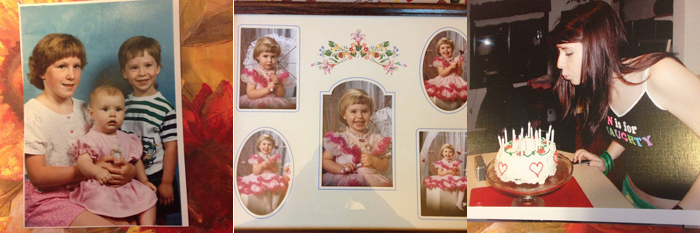
I've somehow managed to have the same face since I was 6. 

When I was 18, someone who hadn't seen me since I was about 6 or 7 recognized me instantly. I've just one of those people whose face really didn't change as I got older. It's retained its round, babyish quality and it's not going away anytime soon. Everyone thinks it's hysterical, but I recently got asked if I was old enough to work where I work and I pretty much will be carded for the rest of my life.

My babyface has become even more clear thanks to my mom, who, for my birthday, gave me a box full of baby pictures. They are all gems. 

birthday2.jpg

Getting older is fun, but it's also scary. When I was younger, I couldn't wait to be older. I always wrote stories about girls who were 22. I never imagined being 25 or 26, but I couldn't wait to be 22, to be mature, to be fulfilled and happy. Maybe I believed in magic for too long because I really believed I would magically fall into a career immediately after graduating college. I also apparently thought people dropped off the face of the planet after 25, which I hope isn't true. 

As I get older, I become more and more aware of the things I've taken for granted, of the responsibilities that I now have to take on, and of all the things I didn't think I wanted (but totally do). I also think of all the assumptions I made about people. I remember thinking about my mom losing her brother when she was 19 and thinking, "well, it was ok because she was grown up." Dear Lord, young Michelle, could you have been more clueless? 

I recently watched the movie Neighbors, which is just as silly as you imagine, but it also made me think about getting older. There is still a part of me that wants to be cool: I miss going to parties, I miss staying up all night and staying out late. I miss eating Taco Bell at 2am. I miss the dirty party houses and endless Netflix parties. I miss them, but I also find myself exhausted at the mere prospect of staying awake all night. I'm so tired; I have to work in the morning; and really, I just want to watch Key & Peele. Am I officially an old? No longer a youth? Am I over the hill? 

I'm not going to worry about it, really. While I miss all the fun of my college years, I don't miss the drama that came with them or the fluctuating persona. I don't miss having to act certain ways around certain people. At 26, I'm ready to just be myself -- and be old. 

The Only Fitness App You Need: PumpUp

I'm pretty sure I've downloaded every work out and fitness app available. It's an ongoing saga. Some weeks, I'm using Fitocracy and that's fine (except it doesn't list calorie counts, just arbitrary points). Some weeks, I just track my cardio work outs on LoseIt. I've downloaded all kinds of apps that claim to build awesome work outs (pro tip: none of them do). 

pumpup1.jpg

A few weeks ago, someone recommended I download PumpUp. They recommended it mostly for the community, but briefly mentioned that you can build work outs on it too. I was intrigued. I downloaded the app and forgot about it for a few days. 

pumpup2.jpg

Cut to a few days later. At work, I opened the app and selected the plus button which brought up the basic menu. I could Start a Workout, Log an Activity, Track my Weight, or Share a Photo. 

Before this point, I'd been randomly browsing the "community" that was recommended to me as "awesome." The community is sort of like Instagram -- a lot of rail thin girls posting pictures of their tiny salads and flat stomachs or people posting thinspo photos masquerading as inspirational, both of which I can do without. (This doesn't include the multitude of men posting their intensely muscled backs with phrases like get it and never surrender added in MSPaint, which I can also do without.) 

I hadn't been impressed until I discovered I could create work outs. 

My frustration with other workout generating apps centered around the fact that the workouts just weren't good. I can do 20 lunges on my own. I don't need an app to do that. I needed an app that could create workouts for a specific amount of time for a specific goal. 

PumpUp does that. It's great. 

All the workouts I've created, including what I've scheduled for the day. 

All the workouts I've created, including what I've scheduled for the day. 

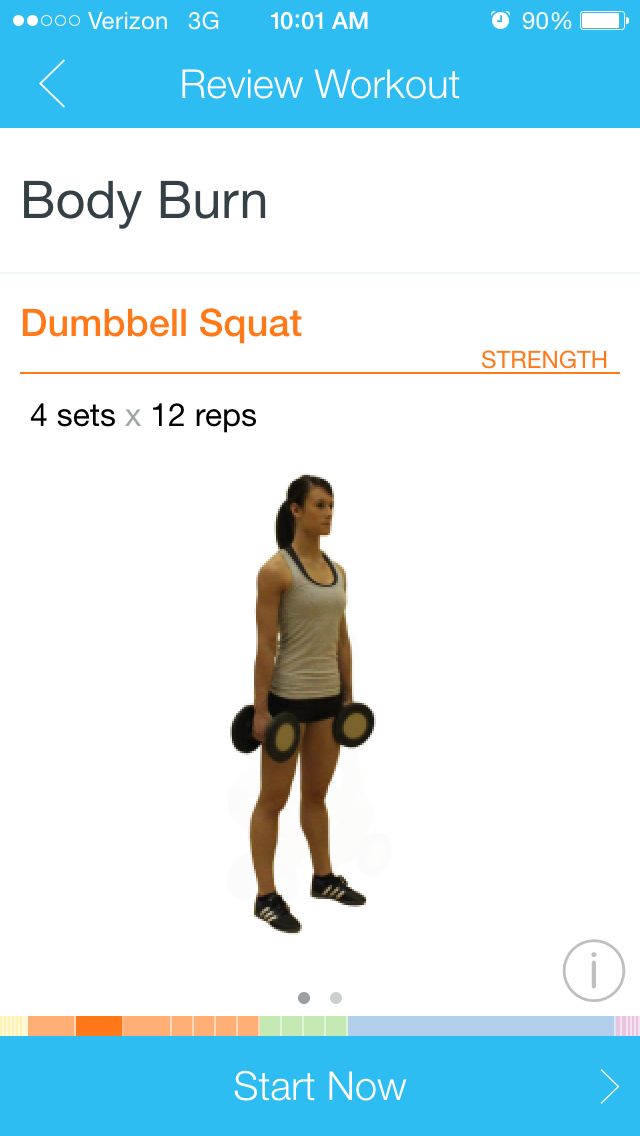
When you select a workout, you can browse through all the exercises. 

When you select a workout, you can browse through all the exercises. 

After you select start now, it times you and tracks your calories. If you need to do 2 minutes of stretching, it times it.

After you select start now, it times you and tracks your calories. If you need to do 2 minutes of stretching, it times it.

The workouts are so nice. I like that it demonstrates how to do each exercise and allows you to swap out exercises. If you did dumbbell squats yesterday and your legs are still hurting, you can swap for lunges or a similar exercise. It's like a workout video, but without an annoying instructor. Just you and the app. 

Each section is colorcoded. Yellow is warmup; orange is strength; green is circuits (if you've chosen to add conditioning to your workout); dark blue is cardio; and purple is your cool down time. Each strength section, rep, and circuit are separated by timed breaks, so you're forced to give your muscles a rest. (I'm really bad at taking breaks.) It always times your cardio. The interesting thing is that cardio is set after your strength-training; the app explains they do this because research shows you burn more fat that way. That sounds good to me!

Mostly, I love the variety. When you create a work out, you can select what you want to achieve: to tone up, to lose weight, to get healthy, whatever. Then, you can select if you're at home, in a hotel, or in a gym. Then, you can select what equipment and machines you have access to: dumbbells, bands, cardio machines, etc. It then takes everything you've told it and spits out a workout in the time frame you requested targeting the muscle groups you indicated. 

It's basically magic. 

Already I've noticed a change in my workouts and my body. I feel more satisfied when I leave the gym and I've noticed an increase in my strength. I'm up to using 10-pound weights (instead of 6-pound or 8-pound) and I can now do 12 real pushups. I've never been able to do a push up in my life. 

I've always toyed around with buying fancy videos or programs, but when you can create effective workouts on a free app, really, what's the point? It's so much more convenient, especially if you already pay for a gym membership. 

PumpUp combines everything I wanted in an app. I'm disappointed it took me so long to find it. As long as I ignore the community aspect, I can get everything I want in my workout from a single, free app on my phone. What's more perfect than that?