Boost Your Immunity with Easy Salmon with Summer Salad Featuring Hungryroot x Hilma*

Easy Salmon with Summer Salad Featuring Hungryroot x Hilma | Writing Between Pauses

If you’re like me, the last few months have been eye-opening when it comes to groceries. I feel like I’ve never saved so much money (spending less on takeout, not going to restaurants, not going to TJ Maxx every weekend) and, at the same time, like I’ve never spent more on groceries. 

We get weekly grocery pick up orders from my local Fred Meyer (my favorite grocery store, hands down!)—but even though I love Freddy’s, it’s hard for me not to be able to pick up my own produce. Just this past week, I got a completely moldy pack of strawberries and out of the 4 sweet potatoes I ordered, 3 were completely rotten and mushy. The day of my pick up! 

That’s I’ve started using Hungryroot more than ever. If you don’t know what Hungryroot is, let me help you: it’s an online, grocery delivery service that helps you stock your fridge with your favorite groceries. They partner with Beyond Meat, Elizabeth, Joolies, and tons more, plus have their own range of groceries. I’ve written about them a ton before; you can read more here. 

With Hungryroot, I can get some of my favorite staples (like my preferred oat milk, vegetables, and more) delivered to my door. 

Hungryroot recently paired up with Hilma. When they reached out to me for this post, I was so excited. More than ever, I’ve been working to boost and take care of my immune system. While there is a lot of misinformation out there, I truly believe that doing all you can to eat healthy and take care of your body is beneficial. 

What is Hilma?

Hilma is a new brand on a mission to upgrade your medicine cabinet: they focus on natural remedies that are also backed by science. With Hungryroot, they’ve curated a selection of immune-supporting groceries. 

Hilma sent me their Immune Support to try. It has six essential nutrients in one little packet that you mix into hot or cold water. (It’s delicious both ways, but on these hot summer days, I’ve been mixing it with cold water and adding it to my morning smoothie!) It contains Vitamin C, Echinacea, Zinc, Ginger, and Turmeric with no fillers. 

If you’d like to try Hilma, you can take 20% off using my code MICHELLE20! I love Hilma’s Immune Support and I can’t wait to see what you think. 

Easy Summer Salad with Salad and Broccoli

Easy Salmon with Summer Salad

When it comes to dinners during the summer, I have a few requests: 

  • Contains my favorite things about the season (corn!)

  • Easy clean up

  • Tastes good

  • Doesn’t make my kitchen 400 degrees

This summer salad checks every single box! 

Plus, it contains a few of my favorite Hungryroot ingredients—and even better, they are all immune boosting! Here are the ingredients: 

Ingredients:

  • 2 packages of Hungryroot’s Hot Smoked Roasted Salmon (or 2 salmon fillets)

  • 1 package of Hungryroot’s Superblend Salad

  • About 1/4 cup of Hungryroot’s House Dressing

  • Garlic Salt

  • 1 package of Sweet Baby Broccoli from Hungryroot

  • 1 cob of corn

Salmon is so good for you and your immune system because it contains vitamin D, which helps keep your immune system working. Not getting enough vitamin D can actually increase your risk of infection. It also has protein and omega-3s, two nutrients that are vital for a strong immune system. Alongside baby broccoli (so much vitamin C!) and Hungryroot’s Superblend Salad (kale, broccoli, brussel sprouts, and more), this dish packs a one-two punch of immune boosting nutrition. 

Here’s how I made it

  1. Start heating up your barbecue or grill. 

  2. Cut the kernels off your cob of corn. Cook them in a pan over medium heat with a little bit of garlic salt and nonstick cooking spray until they are done and slightly charred. 

  3. While your corn cooks, add 1/4 wish cup of Hungryroot’s House Dressing (so good!) to your salad bowl; I added a pinch of garlic salt and some pepper, but this is totally optional. Add your bag of Superblend Salad and toss. 

  4. Once the corn is done cooking, toss with your salad and set aside. 

  5. Create 2 separate foil packets. In one, add your baby broccoli, a drizzle of olive oil, and some garlic salt. Wrap it up. 

  6. in the second foil packet, place your roasted salmon with a little more garlic salt. (Since this salmon is already cooked, you are just warming it up and creating a crust!) 

  7. Cook on the barbecue for about 10-15 minutes for the broccoli, and under 10 minutes for the salmon. 

  8. Serve! 

So easy and delicious, light for the summer and the clean up can’t be easier. 

Want to try Hungryroot? 

I’m so excited to be able to offer you FREE Black Bean Brownie Batter for life from Hungryroot. Their brownie batter is one of my favorite things—I always have a tub in my fridge for emergencies!. Just use the code PAUSES to get 40% off your first order of Hungryroot.

Don’t forget to use code MICHELLE20 at Hilma to receive 20% off your order as well. With both Hilma and Hungryroot, you can have delicious, immune boosting supplies for your pantry and medicine cabinet. 

Disclaimer: Per my disclosure policy, the asterisk (*) in the title of this post denotes that I was provided product for free to review and post on my blog and Instagram channel. However, all opinions remain my own—I created this simple recipe on my own! Posts like these help me keep the lights on here at Writing Between Pauses. I do receive a small commission from use of my Hungryroot and Hilma code. To learn more about my disclosure policy, click here.


Starting My Morning with Cacao Tea Instead of Coffee*

Starting My Morning with Cacao Tea Instead of Coffee* | Writing Between Pauses

Nothing starts my morning like a cup of coffee.

But I’ll be the first to tell you that I know I need to break my coffee habit. (Just typing that sentence hurt a little bit!) Migraines are a huge issue for me and while I’ve gotten way less migraines in recent months, I know that my coffee habit plays a huge role.

I also know that caffeine doesn’t do a lot for my stress level: it can leave me aggravated and on edge.

But… I love coffee. And starting my morning with coffee is a huge part of my routine. And you all know I love routines! Breaking the habit is a hard one.

When Cacao Tea Co. reached out to me to review their product, I was instantly interested. I love chocolate; I love tea; and I love starting my morning with something slightly sweet and delicious. Was this the answer to my prayers?

What is Cacao Tea

What is Cacao Tea?

Cacao tea (which is also known as chocolate tea or cocoa tea) is a 100% natural tea which is brewed from cacao husks (also known as cacao shells). The tea is a loose-leaf style tea which, when steeped in boiling water, results in a delicious tea which tastes like chocolate.

It’s a great alternative to coffee because it wakes you up without containing caffeine. It’s also super gentle and not super stimulating like coffee can be. If you’re in need of something a little more gentle to wake up with in the morning (but don’t like tea!), this is a really great alternative.

Here are a few more benefits to cacao tea:

  • Natural sweetness

  • Heavenly chocolate taste and aroma

  • Delicate stimulating effect, making it the perfect healthy alternative to coffee

  • High in antioxidants

  • Completely sugar-free, caffeine-free, gluten-free and dairy-free.

  • No artificial flavouring, additives or preservatives

How to Brew Cacao Tea

The first time I made cacao tea, I used my tea strainer (a standard metal ball for loose leaf tea) and while I liked that first cup, I knew I needed something better. I checked out Cacao Tea Co’s instructions and they recommend using something covered (like a French press or simply covering your cup). I use my French press to make some for both Danny and I and the difference was huge.

It was so. darn. good. Slightly sweet, chocolatey, and delicious. I was hooked, immediately.

For more information on brewing cacao tea, check out their blog post here.

How to Brew Cacao Tea

My Final Thoughts on Cacao Tea

I’m so glad I got to try cacao tea! It’s definitely provided me with an alternative on days where I know coffee is just going to aggravate a migraine or increase my stress. Plus, it just plain tastes good—so if you, like me, often need that afternoon pick-me-up (but you know coffee is going to keep you awake all night), this makes a great afternoon beverage.

I’m excited to try it iced as well! I think it would be delicious as a cold tea on a hot, summer afternoon.

If you’d like to try cacao tea yourself, check out Cacao Tea Co!

Disclaimer: As indicated by the asterisk (*) in the title of this post, I received product in exchange for this review. However, all opinions remain my own! If you’d like to learn more about my disclosure policy, click here.

3 Things I've Learned in One Year of Freelancing

3 Things I've Learned in One Year of Freelancing | Writing Between Pauses

When I started writing this blog post, I tried to find the previous one I thought I remembered writing around July of last year. As it turns out, I didn’t write very many blog posts last July—I wrote a few of my last beauty reviews and that was it. It wasn’t until August that I wrote a blog post about going freelance—and even then, I didn’t really talk about what had happened, just that I had been laid off and it sucked and I had one of two options. (You can read my first blog post about going freelance here.)

I found the blog post I thought I had written in July and it turns out, I wrote it in November. And again, in that blog post… it was in this blog post that I talked about being laid off and what they meant for me and how I didn’t want it to be the overwhelming focus of my life. (You can read that blog post, about resiliency, here.)

As it turns out, my desire to have the lay off and folding of a company I’d worked at for the majority of my career be the focus of my life wasn’t entirely possible. I’ve still spent time talking about it privately for months; at least once a month, something or other comes up about this company and I have to talk about it or interact with it. I still get calls about this company from the Oregon Department of Employment (fun!) and I still have to wonder: who, exactly, was I looking for?

I haven’t known how to write about what happened to me or this company (agency) that I worked for. It’s not my goal in life to make people miserable or to out people. I love gossiping privately, but this is one of those situations where the gossip isn’t that fun. Maybe because so many people’s lives were at stake. At first, I didn’t feel like it was my story to tell; I wanted my previous employers to be ahead of their own story and reputation and to control the narrative, without feeling like they were pressured by their former employees.

In an ideal world, that is what would have happened. It isn’t what happened unfortunately.

Here’s the truth about my being laid off: I got really, really screwed. My former employers still owe me money—over $5,000 to be precise—and it’s money that, over the last year, I have thought about repeatedly in an “I could really use that as capitol for my own business, to be honest” way. However, I’ve had to deal with the fact, internally, that I will never receive that money.

I will also never receive an apology. I know that now too. And they will never try to get ahead of the gossip or story or rumors about what happened. A lot of explanation is left to employees, which makes it hard for us to talk honestly about our experience without feeling like liars or poor sports, or as if we’re vindictive and out for revenge. None of those things are true.

But how can we talk about what happened when no one is being honest? It’s still not my place to talk about why my former workplace closed. But my decision to go freelance was impacted by one, large fact: I didn’t ever want to be screwed over for money like I was. I wanted to control my money and my product.

I lost all my work for 5 years. I have no portfolio, despite running social media for multiple businesses over 5 years, rewriting websites, writing blog content… it’s gone. All the proof of what I did is gone. And besides, as an agency employee to an agency that no longer exists, I can’t even say, “Well, I did X work for X client while at X”—because that place doesn’t even exist anymore, the bridge with the client has been burned so badly that our work was effectively wiped, and I don’t even have emails to back me up.

At the time I wrote my freelance announcement, I did so with the thought that I didn’t want to spill any “tea” so to speak. I just wanted to make people aware of what I was doing and how it was changing my life. But a big part of my motivation, at that point, was total independence. If a business can go under at any moment, then why not be in control of that business at least? I lost thousands of dollars to a business I had no stake in and nothing to show for. If I’m going to be at risk like that again, it might as well all be on my own shoulders.

This is all to say one thing: going freelance was still an incredibly hard decision. Some days are definitely easier than others. I’ve learned a lot over the last year and I hope that by sharing my story in my career it helps other people make better decisions for themselves and their families.

1. Networking isn’t as terrifying as I thought it would be.

Networking was the big scary idea of freelance that I always dreaded and hated. I didn’t know how to do it and what I did know about it, I didn’t particularly like. It stressed me out in ways that I didn’t really know how to identify.

The truth is, though, that networking is just… being friends with other people.

Networking gets a really bad reputation as being shallow and entirely favor-focused. And, of course, there are some people who use networking very shallowly. That being said, there are lots of people using it in very positive ways that aren’t so bad. I’m one of them!

I genuinely want to be friends with everyone I interact with in a networking way. I want to help them grow. I don’t ever approach anything with the “what can I get out of this?!” mentality. It’s just about building a relationship and seeing what happens. There will be lots of business relationships where I don’t see any “return”—and that’s fine! That’s just life!

So, networking isn’t so bad. And so much of my business comes from networking. I’d be really lost without it.

2. Project management is hard.

If you’re a project manager and you’re reading this, please know that your job is so vital and important.

Because it’s really, really, really hard to manage multiple projects and stay organized. Especially if you’re the one doing the work!

So much of my time goes to admin tasks: keeping Asana organized, making sure my calendars are up to date, invoicing, emails, everything. It all takes so much time. Then, when I start a new project, creating it in Asana, updating tasks, creating due dates… it’s so much work.

Alongside that, managing client expectations is part of project management and, oh my goodness, that is hard too. Staying up to date with multiple clients, keeping them updated, using their various task management and communication systems, scheduling meetings… it takes a lot of work!

This is the hardest part of freelance for me. I thought networking would be my bugbear, but it turns out to be actually managing and organizing projects.

3. Using cycle tracking helps plan my month.

Is this a big disparate to the first two items? Yeah, a little bit.

It was last year that I started noticing something that happened to me month-to-month: I realized that about a week before my cycle started, I had absolutely no energy or motivation. I often let this get me down: why can’t I get anything done?! But then, like clockwork, I would get a huge burst of creative energy usually a week before I ovulated—and I would stay in that energetic phase for about 2 weeks.

As it turns out, my experience is not unique. I randomly googled, “Why am I so creative when I’m ovulating?!” and it turns out, there is a whole system to this. Here are a few great resources I’ve found:

For me, my monthly calendar is broken down week-by-week:

  • The week of my period, I avoid meetings or large events. I simply won’t have the energy and honoring my body’s needs are more important. I usually do a lot of admin tasks during this time, as well as invoicing and planning my month financially.

  • The week before ovulation, I work on calendars for the next month (so in June, I start my July calendars for clients). I’m ramping up my energy and feeling more creative, so this usually works out.

  • The week I ovulate, I schedule meetings, launches, new client consults, and more. This is my most productive week always. I do most of my copywriting and graphic design this week for the next month.

  • The week after I ovulate, I usually schedule in more time to rest after a busy and productive time, focus on admin tasks, analytics, reporting, and client relationships.

A lot of this organization has to do with how my exact cycle lands during the month (which will be different from roughly 75% of the population!)

It has definitely helped me to avoid getting in the habit of thinking, “I’ve lost my mojo, I don’t feel creative or energized by my work!” that then effects the rest of my month. This helps me so much with meeting deadlines. I’m so glad I discovered it and started organizing my calendar effectively.


What a year it has been, huh? I can’t believe we are getting so close. A year ago this week, I was moving into my new house with absolutely no idea what was on the horizon. It’s always good to look back and think about how we’ve changed and what we’ve learned over the last year.

3 Face Masks to Soothe Your Skin

3 Face Masks to Soothe Your Skin | Writing Between Pauses

What a couple of weeks, huh? I feel like the minute I get a foothold on things, everything changes again—for the better in most ways. But it’s hard to be trying to live and work in a world that is in completely upheaval.

For me, during times of extreme stress, the first place I notice it is my skin. A week ago, Danny sent me a funny text message and I was going to reply with a photo of myself making a face. Instead, all I did was stare at myself in the camera thinking, “is that what I look like right now?!” My skin was splotchy, red, dry, dull. Not a good look!

Even worse, I had been keeping up with my routine—but unfortunately, being stressed out about my clients, working, pausing my own content, and more had completely taken over. My skin was on autopilot and it needed help.

It might seem a bit trivial to be writing about this right now. But the truth is, taking care of ourselves as much as we can is just as important as ever. If you’re like me, the self-soothing ritual you enjoy most is taking care of your skin. I’m not writing this to say, “forget about what’s happening” or “let’s move on from what’s going on!” But rather, I’m writing this all to say: you deserve to take care of yourself while also remaining active in an important movement and I hope you are able to take time to show yourself kindness, even if it is in small ways, like buying a new face mask.

Without further ado, let’s talk my 3 favorite face masks for soothing sensitive, irritated, stressed skin.

3 soothing face masks for sensitive skin

1. Hey Honey Show Your Glow Colloidal Gold and Honey Beauty Mask

I received this mask in an Ipsy bag recently and I really love it. It’s pretty gold, smells like honey, and leaves my skin feeling suuuuuper soft. Here’s what this mask promises:

The colloidal gold is an anti-inflammatory which helps prevent the breakdown of collagen and elastin, preventing wrinkles from forming and smoothing the appearance of fine lines, while mica is used to give the skin a radiant glow. 

Honey is also an incredibly soothing ingredient in any face mask, making this one a perfect option for when you want to feel a little lavish while you relax. This mask is best for those looking for anti-aging products, as well as if you have dry skin or are acne prone.

2. First Aid Beauty Pharma Arnica Relief and Rescue Mask

I love First Aid Beauty products—that’s on record—and this one is no different. I also received this in an Ipsy bag and have purchased a full size version of it. It’s relatively affordable (at $32 for a tube!) and feels amazing on. If you’ve never used arnica before, it’s a super soothing ingredient that is often used in bruise creams. I actually keep a tube of pure arnica on hand for when I get a large bruise; if you massage it in first thing, it can reduce the size and color. (Great if you’re prone to bruising!)

This mask contains arnica, calendula, and centella asiatica, 3 botanical ingredients that help heal your skin, as well as soothe it. If you’re experience redness, dryness, or dullness, this is a great mask to try out!

As a warning, it does smell a bit odd (arnica and calendula both have very… interesting smells associated with them). Here’s what it promises, though:

This nurturing mask, which was inspired by the pharmacy, helps relieve the appearance of redness, dehydration, irritation, stress, and tightness. The star ingredient, arnica, is said to have skin-supporting properties that help soothe and smooth. After use, skin appears soft, supple, and dewy.

3. Feel Mindful Palo Santo Soothing Mask

I love Feel products! This one is no different: the Mindful mask (or the Palo Santo Soothing Mask) contains Palo Santo, mushrooms, and niacinamide to reduce blemishes and calm your skin.

I love creamy masks (versus thin or peel off masks) and this one is my favorite. It is thick and rich; you can literally feel how moisturizing it is; and it smells amazing. It contains lavender and chamomile extract as well to soothe skin.

This is the perfect mask for you if your skin is stressed and breaking out; it helps heal existing break outs and prevent anymore from happening, while providing your skin with an extra dose of moisture and soothing.

I often use this mask in particular in tandem with my Aztec Clay mask. If you’re feeling particularly stressed, double masking is really fun; I’ll wear my Aztec Clay (with apple cider vinegar, natch!) mask for 7 minutes, then rinse off, and apply this mask to help soothe my skin and remoisturize. Afterwards, it feels like I’ve just got done having a facial.

Why I Love Having a Daily Routine

Why I Love Having a Daily Routine | Writing Between Pauses

Welcome to my new series all about routines. While developing my own routine over the last few weeks of stay-at-home orders and quarantine, I’ve found myself writing down notes about developing my routine, working from home, having kids, keeping self-care in my day, and staying sane! I wanted to share some of this information with you, to help you succeed and feel more rested, recharged, and productive. You’ll be able to check out all the posts from this series here.

You might be thinking: Michelle, maybe this should have been your first post on the subject of routines.

Well, when I originally outlined this series, I had it first—then I decided to save it for last. A lot of the reason was because I wanted to offer solutions for those who were looking for more structure in their lives. A secondary reason was, however, that having a reason for a routine is extremely personal—and in many cases, why I choose to have a routine might be completely different reasons from anyone else.

There are so many benefits to having a routine that works for you—but that’s also not what we’re here to talk about. We’re talking reasons why: why I started developing a morning and daily routine; what makes it work for me; and why I keep doing it (even if sometimes I do get tired). Let’s talk it out.

I’m not a spontaneous person.

Plain and simple: I have never been that friend that people describe as “so spontaneous!” I am indecisive; it takes ages for me to decide to do anything. I am very easily distracted and I have trouble focusing. So while I’m not spontaneous, I do get off track and in the zone very easily.

Part of the reason I love having a routine is because it eases those decision-making moments for me; instead of waking up and deciding what to do, I have my routine. I don’t have to make one decision that will make me just a little bit more fatigued when I have to make a decision later. I’m not spontaneous and making decisions on the fly simply isn’t my thing—so, routine it is.

It helps ease my stress level.

I’m fairly high strung. This is a descriptor that has always eaten at me: I hated hearing myself described as “sensitive” or “high strung”. I know a lot of people don’t necessarily know what this means, but here it is: it means I’m nervous a lot. Like, most of the time. If you meet me in person, my number 1 vibe is “nervous.” I’m basically this meme:

nervous dog

It sucks to have that be a part of my personality, but it just is. I’m fairly frequently nervous. Which means I’m highly prone to experiencing fairly severe stress levels. It’s something I’m working on, but having a standard routine, with a standard way of doing things, helps me feel less nervous, stressed, and highly strung.

It gives my day structure.

Days when I don’t have anything to do are a nightmare. If my to do list is empty, and stay-at-home orders are still in place, I turn into a monster. I have trouble deciding what to do and I start feeling more and more anxious.

My day needs structure. So even if I don’t have anything on my to do list, I will go through my routine: showering, getting ready for the day, drinking my coffee, going through the motions. Just to keep my day having that backbone of structure. Then I’ll fill it in with activities as I can: picking up those little tasks I’ve been putting off, working on future planning, or more. I need the structure of a routine. I need it to survive, otherwise I will be the nervous dog in the vest even more.

It is comforting.

There is comfort is ritual, in knowing what to expect. For me, that’s what made March, April, May (I have completely forgotten the months of April and May, to be honest, I had trouble writing this list??), and early June so hard. Stay-at-home orders completely changed my days and their routine. I was a mess for a while and I had trouble finding comfort. It’s because I didn’t have my routine anymore, I felt completely adrift. But being able to find a new routine and settle into something is incredibly comforting. If you find yourself frequently adrift and feeling unsure, I cannot recommend routines enough.


I hope you’ve loved my blog series on routines! I’d love to hear your thoughts as well.

As an exciting update, I have just launched my new Freebies page! This page is not accessible from my home page—it’s only for the ones who stick around to the end of this post (or who find it on Pinterest, hint hint!). You can access it HERE and grab 15 FREE products I’ve made over the years—including some I made and ended up abandoning the blog post for. Thanks for reading and I hope you love the freebies!

My Top 3 Unpopular Opinions About Working From Home

My Top 3 Unpopular Opinions About Working from Home | Writing Between Pauses

Working from home isn’t easy. It’s stressful. It’s complicated. It requires making space in your home, setting strict boundaries, and having methods for staying on task.

Unfortunately, doing all that takes time. And in March, when a lot of people were thrown into working from home full-time with no preparation, setting up those pieces was simply not possible. As a result, a lot of people struggled; a lot of businesses saw reduced efficiency and increased distraction. This wasn’t the fault of employees; it just was a weird time for everyone, trying to work in an environment they hadn’t been prepared for. As well, many employees were juggling childcare, illness, increased restrictions, and more.

Needless to say, working from home has been a big topic of discussion.

I’ve been working from home consistently for nearly 2 years—but before then, I worked from home at least 2-3 days a week, if not more. When I was pregnant, I worked from home pretty much every day. It was just easier.

I’m an advocate for work from home or remote work opportunities for those who need them. As an example, working from home works best for me, since I live in a rural area; it lowers my commute time (and therefore, my bills to keep my car running); gives me more time to spend with my son; and allows me to take on more work while remaining productive. Working from home can be beneficial to mothers with small children who want to remain in the workforce, those with disabilities who require home care but want to be able to work, and others.

However, I’ll be the first to tell you: working from home is incredibly challenging. I have some unpopular opinions about it. Here they are.

1. Working from home isn’t a cure-all for bad culture.

For many, the opportunity to work from home is sometimes used as a signal to say: see, we won’t micromanage you or wring you dry or make you miserable at all!

I cannot tell you how untrue this is. Working from home doesn’t mean your company’s culture is good. In fact, encouraging employees to work from home, and then remaining overbearing, poor communicative, and ill equipped to handle a variety of employees needs, is the exact opposite of a good company culture—and it is incredibly common amongst companies that offer remote and work from home opportunities.

If you’re considering taking a job that is remote or offers the ability to work from home, make sure you’re keeping an eye on the company’s culture, asking the right questions about their culture, and more. (I do have some blog posts planned on this topic coming up!)

2. If you want to binge Netflix and relax, working from home isn’t for you.

Here is a common exchange I often had before quarantine.

Stranger: Oh, you work from home? As a freelancer? That must be nice.

Me: Yeah, I have a lot of flexibility.

Stranger: You must get so many chores done around the house! And all caught up on Netflix, huh?

Me:

sure jan

Am I at home doing chores? No. Am I at home watching Netflix and eating chips on the couch? No. What am I doing at home? I’m working. Just like everyone else.

If you think people who work from home are just lounging around, I have 4 words for you: no, they are not.

If you want to work from home because you think it will give you more time for things like chores, watching Netflix, hanging out with your friends, etc., I have a few more words for you: please don’t take these opportunities for those who legitimately need them.

3. Most people do not thrive working from home.

On that same note, I would say: a surprising number of people simply do not do well working from home. It takes a very specific personality, with a large portion of self-motivation and focus, in order to thrive while working from home.

Just as some people don’t thrive in office environments, some people simply will not be able to work from home effectively. Sometimes, working from home is touted as a perfect solution, a great way for businesses to save money. The reality is… if it isn’t effective for even a percentage of employees, then it will not be beneficial to a business. I know many businesses have pivoted to work from home only due to COVID19, even after stay-at-home restrictions are lifted. I cannot tell you how nervous this makes me for those employees who need in-person work solutions to thrive.

My viewpoint is that you should seek out a work situation that is most beneficial to you. There is a reason why workshare offices, like WeWork spaces, thrive! It’s because even some freelancers prefer to work around other people, to have people around to bounce ideas off of and talk to. Working from home can be very isolating and if isolation doesn’t improve your work, then working from home won’t be a good solution for you.


Whew! Now that I’ve got that off my chest… I’m excited to share that I’m seeking out guests posts for the future from BIPOC, the disabled community, and QLGBTIA+ in order to share more insights into career, motherhood, self-care, and more. If this sounds like something you’d like to participate in, please let me know!

What's On My Daily Routine Checklist?

What's On My Daily Routine Checklist? | Writing Between Pauses

Welcome to my new series all about routines. While developing my own routine over the last few weeks of stay-at-home orders and quarantine, I’ve found myself writing down notes about developing my routine, working from home, having kids, keeping self-care in my day, and staying sane! I wanted to share some of this information with you, to help you succeed and feel more rested, recharged, and productive. You’ll be able to check out all the posts from this series here.


A quick note before we begin: I took some time this week to halt my own content in order to give myself space to listen and learn. Like many other white people, and specifically white bloggers, I want to always make sure I’m doing my best to support my BIPOC peers and making space for them to feel heard. In terms of my blog, I am still working on what that means. Pivoting my content in the last year from primarily beauty to career, lifestyle, and more has been challenging—but I know in many ways I need to acknowledge the difficulty not just of mothers in finding and creating their careers, but the difficulty of BIPOC in their careers, specifically in regards to racism, discrimination, and harassment in the workplace. I never want to speak for BIPOC and so, I’m still working on listening and learning and better understanding how I can incorporate this reality into my content in a way that is respectful and honest, without speaking over those who need to be heard.

Thank you again for reading!


What a week it has been! Since my last post on routines, I feel like the world took another hard (but necessary) pivot. If you felt stressed and overwhelmed this past week, I hope you were able to take time to show yourself kindness while also doing hard work.

It’s difficult to jump back into writing about routines when so many of our lives has been disrupted, again. Whether you are protesting or staying home (to protect those who are immunocompromised in your household), we have all had things to grapple with this week. As time moves on, we will find our routines again. I hope these posts remain helpful and timely even then.

In an ideal world, our daily routines create the backbones of our day, giving us time for both our work and ourselves. Routines are by no mean a hard schedule—as I’ve discussed before. (You can read my entire post about crafting your daily routine here.) I want you to think of your daily routine as a few guiding activities that build your day, allowing you to feel good throughout the day and do the hard work that is necessary for you, your family, and your community.

Today’s blog post is all about creating a daily routine checklist—and specifically, what’s on my checklist.

When it comes to my daily routine, I typically divide my day into 3 parts: morning, afternoon, and evening. That’s pretty basic. I have 2-3 things in each part of my day that are part of my routine and I tend to work my entire schedule around them.

Here’s my full daily routine checklist:

this is my daily routine checklist

Typically, the first 3 items are my immediate morning routine: I check my email, I journal or do one page of a 52 Lists book, and then I make breakfast with Forrest. After that, I dive into work and/or take Forrest to my mom’s house so I can have a few hours of work time. Then, I hit #4: checking my daily schedule and reviewing my planner for tasks. As I get emails (or spot them in the morning), I usually take notes in a notebook and write out any tasks in my planner. I review this once a day to get an idea of everything I need to accomplish during the day.

Then, I work.

After lunch, I usually have an hour or 2 with Forrest and make time for a few more parts of my routine: watering my plants and taking Remus on a walk (usually with Forrest as well). These are non-work related tasks, but an important part of my day. After that, Forrest has TV time and I usually review my planner and to do list again and tackle any tasks that need done.

In the evening, I always make time to read for 20 minutes or more, usually in the bathtub. Then, I review my Clockify, making sure I’ve logged all my time and assigned it to the correct client. Without this last bit, I think I’d be a total mess.

That’s it! My daily routine checklist is relatively short, but it helps me really get a handle on my day, my goals, and what I need to achieve.

Now, let’s talk about how I put this routine together.

daily routine checklist

When you think about your routine, I want you to think about it in those same 3 chunks of your day: morning, afternoon, and evening. What things do you find yourself doing during those times? Do they work? Do they not?

Here’s my advice:

  • What things do you need to do for work that will make your day easier?

  • What can you do to make yourself feel good, mentally, emotionally, or physically, every single day?

  • What can you do to start your day on a positive note?

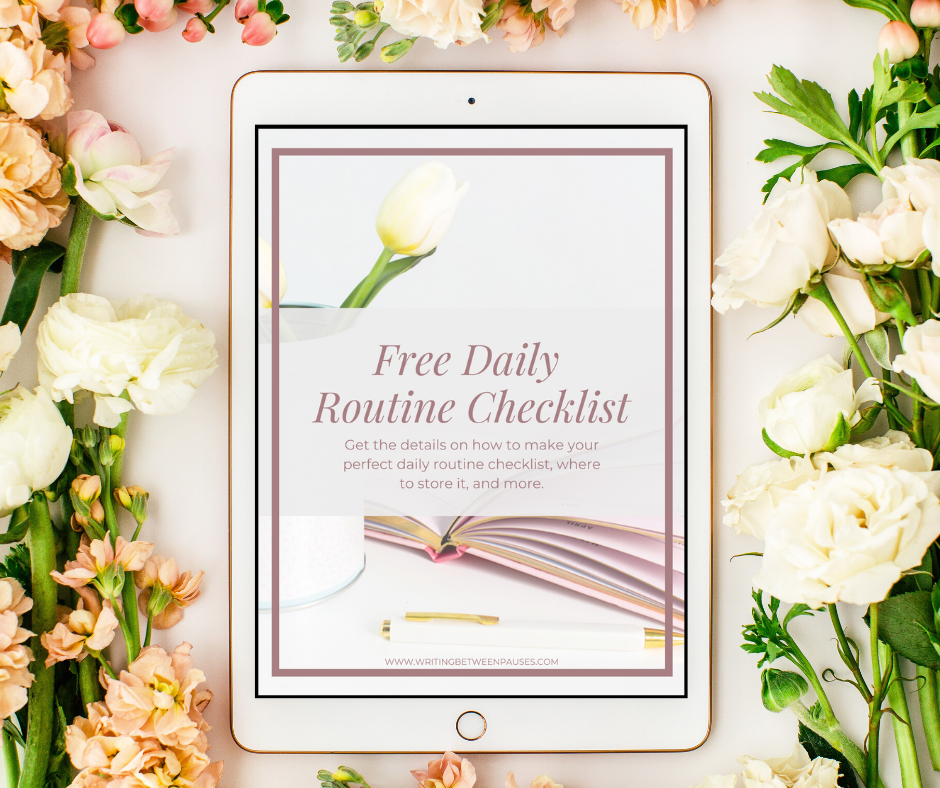
I made a free daily routine checklist builder for you that in it, I help you narrow down your daily routine by having you choose from the following 3 categories:

  • Basics (a few simple ways to start your day)

  • Work routine

  • Things that make you happy

This isn’t meant to be “you can only have these things in your routine!” These are just suggestions if you’re new to having a routine and especially if you’re new to keeping track of your routine day-to-day.

This is how I started putting my routine together: I combined the things that make me feel most energized in the morning (checking my email while drinking my coffee, journaling, and having breakfast) with things that keep me on track for work (checking Clockify and frequently reviewing my planner) and things that make me feel good (spending time with Forrest, taking a walk, and reading).

You can grab your free daily routine checklist builder by signing up for my newsletter!

Free daily routine checklist

Thank you again for reading! Let me know how my daily routine checklist builder helps you—or what you’d like to see included in it!

5 Tips for Crafting Your Daily Work Routine

5 Tips for Crafting Your Daily Work Routine | Writing Between Pauses

Welcome to my new series all about routines. While developing my own routine over the last few weeks of stay-at-home orders and quarantine, I’ve found myself writing down notes about developing my routine, working from home, having kids, keeping self-care in my day, and staying sane! I wanted to share some of this information with you, to help you succeed and feel more rested, recharged, and productive. You’ll be able to check out all the posts from this series here.


So you want to start a daily routine, but you don’t know where to start? I’m glad you’re here, because this has been a topic I’ve been so excited to write about.

Having a daily routine can feel, depending on your point-of-view, super easy or super complicated. It just depends. I’m sure there are plenty of people (and maybe they’re like me!) who say, it’s not that hard, just do the same things every single day. Boom. Routine. But for many, it’s just not that easy.

If you’re someone who struggles to stay productive, or you get easily overwhelmed or distracted, creating a daily work routine that helps you get more done (without feeling like you’re being micromanaged) can be really challenging.

So, here are my 5 tips—which include step-by-step instructions for creating your daily routine.

1. Take time for what matters to you.

As I’ve written in previous blog posts in this series (you can read them all here!), no single routine will work for every person.

Step 1: Write down a list of 10 things you want to do everyday that will be impactful and meaningful to you. What do these 10 things mean? Are they part of a larger goal for you to meet? Here are a few examples of what I would write down:

  • Journal

  • Write my to do list

  • Exercise/hit 10,000 steps

  • Send LinkedIn messages

  • Drink water

  • Make bed

Step 2: Look at your list and order these things in a way that makes sense. Right when you wake up, what are 2 things you can do right away that will make a difference in your work day? How can you arrange this list in a way that makes sense for your day and that helps you feel motivated?

Step 3: Once you’ve ordered your list, think of realistic ways to incorporate these things into your routine everyday.

For me, that’s make my bed (which isn’t related to work, but does make me feel better) and then write my to do list. Typically, those are the first things I do everyday. I might be interrupted, but I also try to do those 2 things first—then, I jump into journaling and work tasks.

2. Set realistic expectations.

Are you going to wake up, make your bed, run 5 miles, make a gourmet breakfast, and still get to that 9am Zoom meeting on time? Let’s be honest: unless you decide to wake up at 4am, probably not. (Although, if that’s your thing, please go for it!) My point is that if you’re someone who has never done those things, they probably won’t start day one.

Make sure your list and routine is realistic. Here are a few examples based on my routine:

  • Unrealistic: wake up, shower, make bed, work out, make breakfast for Forrest & I, get Forrest to my mom’s, journal, work.

  • Realistic: wake up, make bed, work for an hour before Forrest wakes up, make breakfast for Forrest & I, take Forrest to my mom’s, journal.

The reality is if I have an extra hour in the morning, I’m not going to shower or work out. That’s just the truth. Those 2 things make me feel good, but in terms of how my life works, I prefer the extra hour.

As you work on your lists in tip #1, remember to keep your expectations realistic, what you can and cannot do, and what makes sense for your day.

3. Keep track of what does and does not work.

This is something I often repeat and I know for many people, they ask, what does that really mean? Let’s take a look.

Step 1: You’ve created your list from tip #1, you’ve ordered them, and you’ve started incorporating them into your day. Great! Now what? The first step here is to keep track of what feels right and good in your routine. That means, using a journal or scratch pad to keep track of your day in some way. This might just be jotting down notes, it might be checking off that list you wrote earlier… whatever works for you.

Step 2: Does something feel out of place? Is there something you meant to do but keep forgetting? Maybe it’s not as important as you originally thought it was or maybe it simply doesn’t make sense in your routine.

Step 3: Cut out the things that aren’t working. For me, this was removing pressure to work out in the morning or at a certain point each day; it just made me feel overwhelmed. Some days, I do aim for a work out, but day-to-day, it’s simply not a part of my routine. This also means keeping the things in your routine that aren’t working and becoming more aware of why they work and how they impact your day.

4. You’ll never be able to schedule your whole day.

This is more of a note, but: a routine isn’t a schedule. It isn’t strict. It’s just a series of things you do every day that make you feel good or improve your productivity (or ideally both). It’s easy for them to get conflated!

The truth is, it would be great if we could all schedule our day out to the 15-minute block. Trust me, I’ve tried that in time blocking—and even for someone like me, who thrives with routine, it simply doesn’t work for most people’s lives. Things come up. Feelings change. Needs change.

A routine is something that changes with you, that simply provides a blueprint for your day. How it actually adds up is entirely up to you. Some days, I don’t make my bed right when I wake up—but I get to it eventually because it’s a part of my routine that I find something. Some days, I don’t write in my journal because I don’t feel like, or I have more pressing work tasks to work on, or any number of things.

You can’t schedule out your whole day, especially if you’ve never been the type of person to stick to a strict schedule.

5. Protect yourself from burnout.

Step 1: Notice the signs of burnout. Here a few things to look for:

  • Fatigue or exhaustion that you never experienced before.

  • Feeling like you want to get things done, but you simply can’t find the energy to do so.

  • Physical symptoms you never had before that aren’t tied to any specific illness.

  • Feeling pessimistic and detached.

The symptoms of burnout can be very vague—but if you’re experiencing them, you probably recognize them. With shelter in place orders and quarantine, many of us are working longer hours from home; the lines between our home lives and our work lives have become incredibly blurred; and we all have more on our plate than before (work anxiety, anxiety about the economy and social tensions and more, plus childcare and homeschooling). Burnout is real.

Step 2: If you’re starting to feel totally overwhelmed, here are a few different things to do:

  • Scale back your routine. Strip it to the minimum. I’m very goal-oriented, but I’ll be the first to tell you: when I start to feel signs of burnout, I know I need to let go of the goals for a little bit.

  • Add more self-care and self-soothing to your daily routine. A long morning shower might cut into your work time, but will it help soothe you? Getting all your work done early so you can play Animal Crossing might feel flaky, but will you feel better?

  • Speak to someone. There are lots of at-home resources right now for counselors and therapists. TalkSpace, or just contacting a local therapist, will make it easy. My therapist has been offering teleconference options that are secure since March. If you don’t want to talk to a therapist, reach out to a friend or family member, make sure they have space to help you, and let it out.


There you have it! My 5 tips with step-by-step instructions. Are you working on your daily routine? Let me know how it’s going in the comments!