What Is a Sales Funnel (And Do I Need One?!)

What Is a Sales Funnel (And Do I Need One?!) | Writing Between Pauses

If you’re a blogger who wants to make money, or a small business owner who wants to use your website to make more sales, then you need a sales funnel.

But for many people, they simply don’t know what that is. And we can’t create something to make our lives easier if we don’t know what it is or why we need it. So let’s talk about it. In this blog post, I’ll break down what a sales funnel is, the steps to creating one, how to automate effectively, and finally, provide a full example of a sales funnel.

First and foremost, before we talk about what a sales funnel is, let’s talk about why you need one. Let’s look at an example and I’ll use this example throughout the blog post. In our example, our business owner is named Sarah and she runs an Etsy shop that sells primarily personalized nursery signs, as well as other personalized art pieces and printables. Sarah has a decent number of sales on her Etsy shop, but wants to see that number increase—however, her art takes up a significant amount of her time, so she doesn’t want to have to spend hours of her day posting on social media, toying with ads, and more.

How can Sarah use social media and her existing blog and website effectively to increase sales?

The answer is a sales funnel. It will take some time to get set up and require a little bit of effort at first, but as time passes, she’ll be able to focus less and less time on it—and more time on her art.

Sarah needs a sales funnel because it will help drive sales to her Etsy store, give her a list of potential customers to turn to whenever she needs it, and give her control over that list of potential customers.

What is a Sales Funnel?

A sales funnel is a fancy way of saying: a system that drives potential customers from free content to paid content or products (or services).

The widest part of the funnel is the entry step: lots of people will enter, but not everyone will get to the bottom of the funnel. The middle part of the funnel is where you provide more and more targeted content. The bottom of the funnel is making a sale. That’s it!

However, a sales funnel won’t be the exact same for every single business or individual. Let’s talk about design.

How to Design a Sales Funnel

Think of a sales funnel as a customer’s journey towards buying your product. You want to be on their mind every single step of the way: invested in your brand, your product, and what both can do for them. For that to be helpful, you need to know who your ideal customer is and what motivates them.

What do they want from your product? From your content? What would be most helpful to them?

If you’re already making sales, what questions do you find yourself answering the most? What things do you notice customers needing?

And more specifically, besides your product and service, what is your customer interested in? What draws them in?

Once you answer all these questions, you can create a profile of an ideal customer. You’ve probably heard of these before; you can give this ideal customer a name, but you don’t necessarily have to. If you have more than one ideal customer profile, you can create a group of them. Once you have an idea of your ideal customer, you can design a sales funnel for one ideal customer (if you have a group of them as an example).

Let’s look at our example: Sarah sells personalized nursery signs, as well as other personalized art pieces. Her ideal customer for this sales funnel is currently pregnant women, aged 22-38, who enjoy: Pinterest, home design shows like Fixer Upper, and Instagram influencers like Elsie Larson. They want to design their nurseries to be beautiful, but functional, and want to learn more about design. That’s Sarah’s ideal customer; we’ll call her Helen. Now, what would be the first step towards getting Helen to make a purchase?

Step 1: Provide free content.

Starting with Sarah’s website, what content would Sarah post to attract potential customers like Helen? Here is what I would outline for Sarah:

  • Design-focused content

  • Nursery-focused content

  • Using Pinterest as a promotion method

Sarah might consider questions that her customers typically ask, such as: “Can I see some examples of nurseries where you have signs hanging?” or “What are the best ways to hang this sign?” She might consider content that:

  • Centers around customer photos of how they’ve styled their signs (in a style that would attract a potential customer like Helen)

  • Provides the best additional decor to style her products

With providing free content, regardless of your product and service, there is a thin line to walk between providing your services for free and providing just enough value that customers remain interested. Provide enough free content that aligns with Helen’s interests and Helen will become a fan.

Step 2: Create an email list where you provide consistent (still free) content.

The first time Helen finds a blog post from Sarah, she might get a pop up with a CTA to join Sarah’s email list. She might skip that for the time being. By clicking Sarah’s blog post from Pinterest, however, she’s still entered the funnel—she just hasn’t moved down a step. But let’s say a week later, Helen returns to that blog post; she wants to see those signs again and how customer’s have styled them in a farmhouse style.

She returns to Sarah’s blog post, because she saved it to a board on Pinterest, and gets that pop up again. She decides to sign up for Sarah’s mailing list.

Congratulations! She has moved down the funnel.

By providing great free content, Sarah attracted Helen as a fan. By having an email pop up, she invited Helen to join her mailing list and receive even more tailored, free content.

No matter what product or service you offer, you need an email list. Read that twice, please. It doesn’t matter if you started your website or blog yesterday. Sign up for Mailchimp or Mailerlite and get your email list going now. Why is that? Because with an email list, you own those subscribers. Your website can go down or Instagram might get deleted, but no one can take your email list from you.

Step 3: Use your email list to launch low-cost products.

Sarah uses her email newsletter to highlight new products in her shop and provide styling options. Every month, she styles a sample sign in a different style or creates a piece of personalized art to style. This keeps her potential customers interested and aware of her products.

She also occasionally offers discounts on products in her email. She might offer 20% off orders for Valentine’s Day or 31% off orders for Halloween. No matter what, she provides a way for her subscribers, and her subscribers only, to receive a discount on her products.

Your newsletter and email list should be a place for you to continue to provide valuable content for your potential customers: your list isn’t purely to sell to. If you only send them sales-focused emails, you will see a lot of unsubscribes. For businesses like Sarah’s that sell products, using a newsletter that highlights new products and continues to provide valuable, ideal customer focused information is the best option. However, for other businesses, sending a newsletter that only provides value for a while is your best bet; an example here would be if you are a coaching service, you would want to send essentially shortened blog posts that answer common questions or that advertise your (already free) blog posts. You would only occasionally send an email advertising your services. Let’s talk about why.

Step 4: Use that warmed up email list to sell high-cost products or services.

Using her newsletter to continue to provide value to her customers, while also advertising her products, is an important part of the funnel. Helen might just read the first 3 or 4 newsletters she receives; but in that 4th or 5th one, she sees a 30% discount for signs and decides to finally go for it. Congratulations! Helen has gone through the entire funnel!

But let’s go to that other example: if you’re a coach, what you’re selling is a service, not a product. It might cost more than a personalized sign. In this case, you would use your email list to warm up potential customers. Send them 4-5 emails in a drip campaign (this means they receive constant, small pieces of content designed to move them through your sales funnel) that aren’t about making a sale: these are purely to provide information. If you were a content coach, like I am, you might send emails about writing better Instagram captions, that show the data behind Instagram and making sales on Etsy stores, and more. Then, you might end that drip campaign with a single email that advertises your product or service. This gives your subscribers more of a chance to purchase from you—because they know you, they know your service, and they know that you know what you’re doing.

Think of your email list as a select group of people who love your blog content—but also want more from you. This is your chance to really flex your knowledge, show off your products & services, answer questions before they ask them, and then advertise what you do best. It might take a while to warm your email list up as much as you’d like, but having a plan for emails every month to provide the most information you can without giving your business away for free will keep them coming back for more.

What’s Next?

So, you know what a sales funnel is and we’ve walked through the primary steps. When creating your own sales funnel, it will probably be helpful to refer to this blog post and these steps. As you outline your plan, write out what you plan to do—and then write the steps of those plans separately. This might look something like this:

  • Step 1: Provide valuable content on setting up your first blog

    • Blog posts include: [topic 1], [topic 2], and [topic 3]

    • Promote on Pinterest and Instagram

    • Instagram hashtags include: [examples]

    • Instagram accounts to tag include: [examples]

    • Instagram story to promote needs hashtags [1, 2, and 3]

That will help you not just create a funnel, but create a plan for the content you want to create, including social media posts, Pinterest pins, and more. From there, outlining email sequences, what products or services you want to highlight first, and more will be incredibly helpful. If you have a network of fellow bloggers or business owners, asking them to promote your blog posts can be extremely helpful as well.

I’ve created a small template you can use to outline your initial steps.

Click here to view & download

Thanks for reading! I hope this helps you design a sales funnel to improve your business. If you need help with any step, please don’t hesitate to send me a note.

How to Create A Quick Morning Beauty Routine

How to Create A Quick  Morning Beauty Routine | Writing Between Pauses

What energizes you in the morning?

What makes you feel totally prepared for a big day?

Routines are something that helps me feel more energized throughout the day. The less routine I have, the more likely I am to drift, feel anxious, and struggle to complete tasks. But if I have a routine in place where I do the same things upon waking up, then transition into work, I feel energized and more focused.

However, developing a routine when 1) you have a child and 2) you work from home can be a huge challenge.

A huge part of my morning routine has always been my beauty regimen. If you’re leaving the house for work, or school, or whatever, you know the drill: you have to do a few things before you’re ready to face the world. But what those things are can vary person-to-person.

One thing that doesn’t change is the fact that a beauty routine can help us feel more awake and ready for the day—and ready to transition into whatever routine (work, taking care of kiddos, whatever) you have that day! However, implementing a consistent routine that makes you excited can take time and effort. I want to guide you through the process so you can get a routine in place that makes you feel ready to face the day—and most important, makes you feel good every single day.

Why A Good Beauty Routine Matters in the Morning

You want to start your day feeling GOOD. If you’re not a morning person (and let me tell you, I woke up sick today and I’m not feeling the world at all), a good routine that makes you feel your best is a great place to start.

To me, a beauty routine isn’t just putting on make up or washing your face. It’s a combination of things that help you start with your best foot forward. Here’s my morning routine, as an example:

  • Make & drink my coffee

  • Light a candle

  • Make my bed

  • Take a shower

  • Wash my face & moisturize heavily

That’s it. If I’m not leaving my house, just working, then that’s all I really need. But nothing makes me feel better than having my bed made, my room smelling good, and my body feeling clean. Plus, if I’m not feeling my best (like right now), it gives me something to focus on and put energy into that also revitalizes me.

Now, let’s talk what makes a great beauty routine.

1. Know Your Needs

Your beauty routine might not be mine (although you might find inspiration in it). So first things first, know your needs: what do you want to accomplish with your beauty routine in the morning? Feeling fresh after a night of sleep? Keeping your dry skin moisturized throughout the day or your oily skin matte?

What makes you feel best? Pampering or taking on a task that you don’t really love? What would help you feel energized.

Here are a few places to start:

  • Does taking a shower make you feel ready for the day or does it sap your energy? If it isn’t comfortable for you, switch your showers to the evening.

  • Do you have a face wash that fulfills all your desires? What about moisturizer?

  • What would help you feel most excited for the day? A body lotion that smells like your version of heavy, a new cozy sweater?

2. Pick Your Products

A Simple Skincare Routine | Writing Between Pauses

The products you use in your routine are going to make a world of difference. I’ve included a good skincare routine checklist to help you pinpoint specific areas and the most basic steps you need for fresh skin every single day.

However, sometimes, it’s more than just a good, basic routine. What makes you feel luxurious? I want you to think of at least one thing that you love using every single day and start to include that in your routine. No more saving your favorite perfume for special events or that lotion that makes you feel like a queen. Use it today. Use it every day. Make it part of your routine because you deserve it.

3. How Much Time Do You Need?

Time is relative. When I say “quick” what do you think of?

For me, it’s 20 minutes or less. If I’m doing my hair (aka I need to blow dry and/or curl it), it’s 45 minutes. For some people, however, those times might be way too long or way too short for what they want to do.

It’s all up to you.

What time do you wake up in the morning? When do you start work? How much time do you have to get a routine in place? Are you willing to wake up earlier, or do you want to sleep in a little bit more?

Whatever time you choose, make it something that works for you. If you want to spend 5 minutes putting on body lotion and thanking your body, then incorporate that.

4. Makeup Is Optional

It goes without saying: your beauty routine doesn’t have to include makeup. But if you want it to, choose a few items of make up that make you feel your best. If you’re trying to condense your beauty routine, then committing to a full eye look or winged eyeliner every single day might not be something you can do.

However, if winged eyeliner makes you feel good, find a product that works perfectly and stick with it. Incorporate it into your routine so you always have time to get it done. Whatever it is you choose to include in your make up routine, make sure it makes you feel good, whether that’s an eyeshadow look you love or a lipstick that makes you feel more powerful.

5. Keep Your Routine Evolving

No two days are the same, so why should your routine be the same? Being able to adapt, whether it’s with skincare concerns or time constraints, can help you feel more confident when you start your day.

How to Approach Your Routine Every Day

daily beauty routine

Every evening, I write down a few things I want to start my day with. Like I said, mine usually includes making my bed, drinking my coffee, and focusing on doing one thing that makes me feel really good. (Today, as an example, it was coating myself in Vicks Vaporub and filling my diffuser on my desk with peppermint essential oil.)

You can use the graphic I’ve included to write down your beauty routine in the evening so it’s first thing on your mind in the morning. You know how prepared you need to be for each day, so take that into account, as well as how much time you have allotted and what you need to focus on.

Moving forward, establishing a routine will help you feel more pampered and ready to start each day. Take time for yourself so you can get your work done without feeling deprived.

8 Empowering iPhone Wallpapers to Download Right Now

8 Empowering iPhone Wallpapers to Download Right Now | Writing Between Pauses

About a week ago, I posted a graphic on Instagram thatI’d whipped up late one night. I loved it almost immediately, and it was totally a fluke. I didn’t set out to make it! Using a bunch of free Canva elements, I made a few more to post on Instagram. Just fun, slightly cheesy quotes about being exceptional.

I know these kind of quotes aren’t super popular with certain crowds. However, in the last few months, I’ve started writing down and saving simple mantras that make me feel empowered. I’ve included a few of them in these wallpapers because I find them so helpful.

Seeing these mantras every single day has helped me stay on track. Therefore, iPhone wallpapers feels like a perfect option. I had such a great response to that Instagram post that I decided wallpapers was the next step. I turned those Instagram graphics into wallpapers and voila! Here they are, ready for you to download.

how to be more confident in my career
female empowerment iphone wallpaper

To download, please use the subscribe form below to sign up for my newsletter list! You’ll receive a confirmation email shortly to confirm your subscription that includes a link to download all 8 wallpapers.

.

(If you have any issues with this, or don’t receive an email, don’t hesitate to reach out to me on Instagram or Twitter!)

If you use these wallpapers, feel free to tag me on Twitter or Instagram, and use the hashtag #thisweeksgoldstar on Instagram!

Beauty Review: January 2020 Ipsy Bag

Beauty Review: January 2020 Ipsy Bag | Writing Between Pauses

Starting these Ipsy bag posts… man, what a challenge. I never really know what to say, but I guess one of the best things I can talk about is how my month was and how this bag made me feel. One thing I really want to emphasize is giving yourself little gifts throughout the month; while you’re building your career, or taking care of your child, or whatever… you deserve a few things for yourself.

And I want those things to be worth it. So month to month, the one thing I look for in every Ipsy bag is value. Is this bag both valuable monetarily and also to my life? Do the products make me feel good? Or do they make me feel blah?

So often, my Ipsy posts have been reflections of how I’m doing that month. Some of my saltiest reviews came when I was not feeling so great.

For a little context: the last few months have been some of the hardest of my life. I’ve struggled a lot, but I find myself doing better and better as time goes on. But December and January were definitely rougher months in the scheme of things—and honestly, November too.

With that being said, lately I’ve needed my self-care items to be even bigger than before. I’ve needed my therapy sessions; I’ve needed my bubble baths; I’ve needed my evenings to be quiet. Sometimes, I don’t get those things. Sometimes, self-care is just going to bed early or making an extra pot of coffee or closing my office door for 5 minutes to silently scream.

Not to give it all away quite so quickly, but this month’s Ipsy definitely felt like a bit of a let down. The last few months definitely have. But this month’s in particular is very disappointing and I’ll hit why on those specific items. Let’s get started, shall we?

You can read my past Ipsy reviews here. If you want to try Ipsy, you can sign up using my referral link here.

Is Ipsy Worth It?

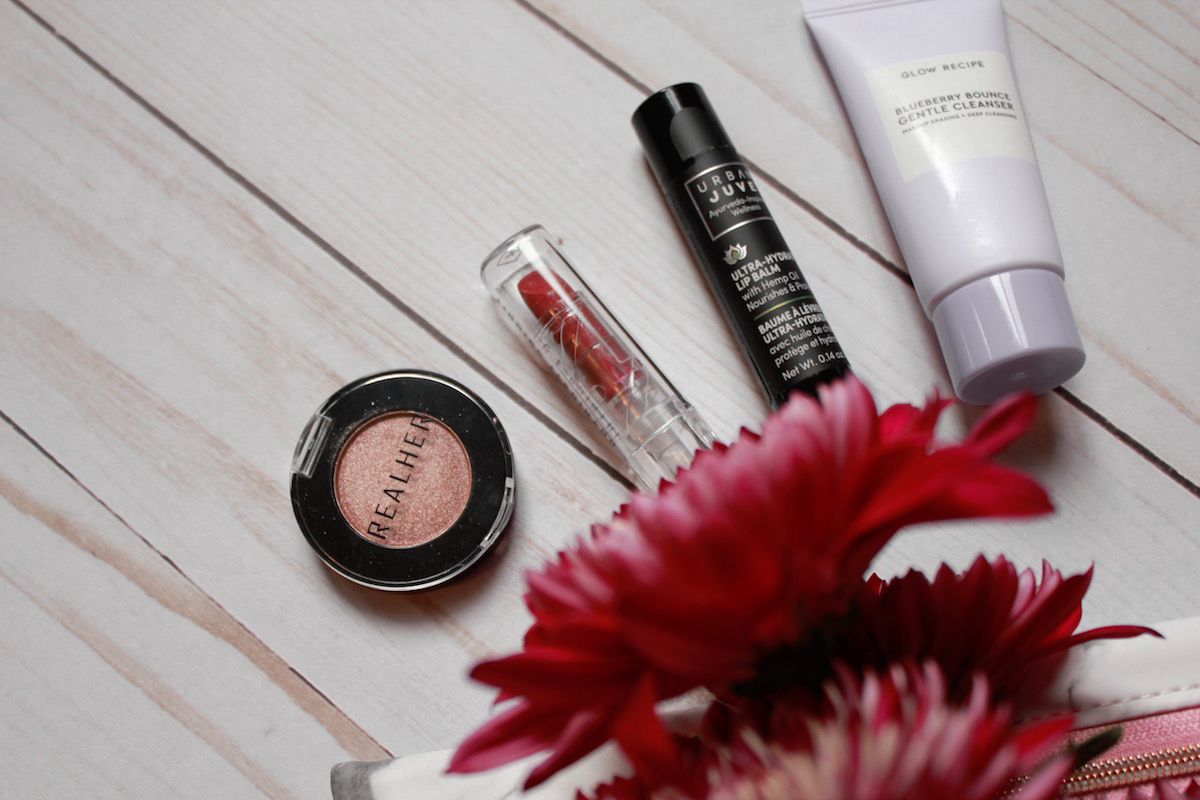
1. Glow Recipe Blueberry Bounce Cleanser, $3.19 value

I love the Glow Recipe, it’s such a great brand, but as I’m trying to repair my skin’s pH barrier, I’ve become more and more picky about cleansers I use. This one has a lot of pure soap ingredients—and it foams in a way I find slightly repulsive, for lack of a better word. The texture is akin to snot. There, I said it. It’s snot-like! It’s a snot-like cleanser and I don’t want to wash my face with it and despite being called “Blueberry Bounce Cleanser,” it smells like a Dollar Store.

I don’t like it! There!

I’m relegating this little sample tube to my travel bin; I think it’s OK for pH (I haven’t noticed any serious issues cropping up), but the weird smell alone is enough to make me avoid it. I give it a solid 3/10 in terms of how much I enjoyed it.

A full size tube is 160 ml and costs $34 (WHEW!). This sample tube is only 15 ml, making it’s value around $3.19. If I was nice, I would have rounded up to $3.20, but… I didn’t.

2. Luxie Fan Brush, $18 (Not Pictured)

I fully forgot to grab this brush while taking photos and didn’t notice until I was editing afterwards and wondering where my 4th item was. Then I remembered, “oh yeah, I got a 4th fan brush.”

You read that correctly: my 4th fan brush.

I have so many fan brushes, I expect to find all my cleanser samples fanning my blush samples in my bathroom any day now. (The blush samples are the kings of all the samples I receive, natch.) I have fan brushes coming out of my eyeballs at this point, which is funny only because no one needs a fan brush. It is the most useless brush. I don’t even wear highlighter anymore! What else is a fan brush used for? That’s right, nothing.

0/10. It is pretty. But… 4 fan brushes, guys. I’ve gotten 4 of them.

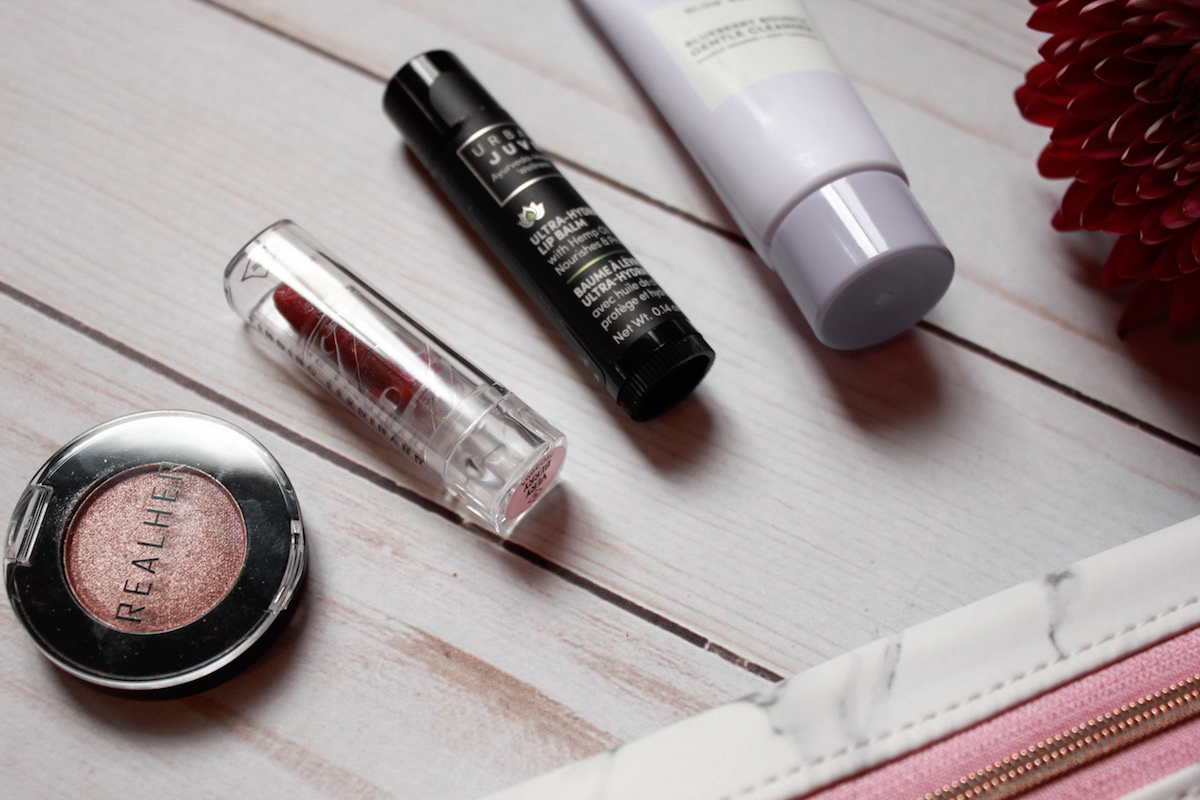
3. Urban Juve Lip Balm, $10

I love a lip balm moment, but guys. $10 for a lip balm this big?? For comparison, the Glossier Balm Dot Coms come in a 3 pack for $30, making them $10 a piece. And they have 0.5 fluid oz (which is HUGE!) This little lip balm has… 0.14 fluid ounces. Sorry, but that’s highway robbery. It’s not any different from Burt’s Bees either, it just has hemp in it!

If I’m going to spend $10 on a lip balm, it better be the size of a Moon Pie. I’ll take Glossier’s tubes of lip balm, but they’re on thin ice anyway. $10 for a Burt’s Bees size tube? Girl. 0/10. It’s just minty! It’s not even special!

Everything that comes in Ipsy Glam Bag $13

4. Finding Ferdinand Lipstick in Very Berry, $6

You’ll be shocked to learn that I love this lipstick. Yes, I said it! I love one thing in this bag! And it’s this lipstick. It’s tiny, it’s cute, and it comes in a clear component that literally made me squeal out loud. I like it! What can I say? It’s a nice, bright berry color and perfect for spring. The formula is a little more dry than the average lipstick, which makes it more long lasting than a high shine formula. And at only $6, it’s pretty reasonable for a sample size that you can carry in your purse with ease. I give it an 8/10.

A full size is valued at $30 and the mini is $6. You can buy a set with both for $33 (savings!)

5. REALHER Eyeshadow in Victorious, $3.11 value

So, this shade is apparently in the Conquer from Within palette, but to me, that looks like a completely different color. Mine is a shimmery, pink-brown (I’d describe it as a dusty pink with a gold sheen if I was pressed). That looks like a straight champagne. They describe Victorious in the palette like this: “Metallic light slate. Perfect color to add a touch of highlight to inner corner of eye, or to work over entire lid.”

Ipsy, in comparison, describes it like this: “Rose gold is a universally flattering shade that’s always on-trend—this super pretty, shimmery color will quickly glam up your beauty looks, but it’s versatile enough to wear during day or night.”

Metallic light slate and rose gold are… not the same color whatsoever. So is this the same shade? A different one? With the same name? I don’t know!! Is this an extra that they slapped a random sticker on that they just needed to get rid of? God, I suspect so.

Either way, I did use the cost of that palette to calculate the cost of a single shadow.

Apparently, you can buy this brand in Neiman Marcus. Remember when Neiman Marcus was name dropped in like every song in 2004? What a weird time to be alive that was.

All that being said: I think I’ve received this same shade of eyeshadow about 40 times from Ipsy and I still am not going to wear it. It’s a perfectly fine eyeshadow, but… it’s not new! Ipsy, stop it with the brown-pink eyeshadows! It gets a 5/10: not awful, but I’m not going to wear it, so…

Glow Recipe Blueberry Gentle Cleanser

Final Thoughts

The total value of this bag is… $40.30. Womp womp. That’s pretty low. That may be in the running for one of the lowest valued bags I’ve gotten in… quite a while, actually.

If you can’t tell, there were some bummers in this bag. I don’t know why, but I get really annoyed when the cost of the bag is dependent on one item. An $18 brush does not a high value bag make, monetarily or enjoyment wise. I don’t need an $18 fan brush because I’ve already been sent 4 $18 fan brushes! That single brush ups the value of the bag significantly, but the other items are all valued at less than $10—except for the bizarre lip balm, which is so offensive at $10 that I actually find myself getting keyed up and mad.

Did this bag make me feel good? Honestly, not really. It was just sort of another thing, you know? I do love the make up bag—what blogger doesn’t love a bit of marble, huh?—but besides the lipstick, I wasn’t excited to use anything.

Here’s to hoping next month brings me a little bit of joy. I need it, y’all!

What Are the Benefits of Journaling in Your Daily Routine?

What Are the Benefits of Journaling in Your Daily Routine? | Writing Between Pauses

Do you keep a journal? A diary? A planner?

More specifically: do you have somewhere to dump all your thoughts, feelings, anxieties, tasks, plans, dreams? It doesn’t have to be a traditional diary. It can be in the daily part of your planner, or the extra notes pages in the back. Or it can be an app you use every day. A notebook you use for your grocery lists. Your Notes app. A Word document on your computer or your Google Drive.

Do you see what I’m getting at?

I’m a lifelong journal keeper. And recently in therapy, my therapist asked if I journaled and I basically started listing all the years I’ve kept journals and diaries meticulously. (My earliest saved, complete journal is from my sophomore year of high school. It’s a Harry Potter notebook.) We talked about the benefits of journaling and things I can start journaling about everyday to start thinking more about.

Journaling has so many benefits. Professionally, mentally, emotionally, personally… and making journaling part of your daily routine is super easy. There are so many ways to incorporate journaling—but that’s not what we’re here to talk about.

Journaling in the traditional sense isn’t for everyone; some people just plain don’t like writing by hand. And that’s ok! You can use whatever medium you like best. But, I do think journaling, no matter how you choose to do it, can benefit you in the long run. Think of it as self-care… and these are all the benefits.

1. Organize your thoughts in your journal.

I spend a lot of time journaling purely to organize everything I’ve got running through my head. I always have a million concerns, tasks, things to think about, ideas… and writing them down helps a lot. Sometimes I do four-point brain dumps, where I organize my journaling into MUST-SHOULD-COULD-WANT TO to help me roll through my tasks and overwhelming, pressing thoughts of what I want to do that day.

Other times, I just sit and write out something I’ve been thinking over. An idea that I’m not sure if I should go for or not.

Journaling gives you a chance to pour out everything you’ve been thinking about. Something you want to refer back to or just want to work through. Use journaling to organize your thoughts, answer your own questions, and work through any problems you might be having.

2. Improve writing skills by journaling.

Plain and simple: if you want to be a better writer, journaling will help you get there.

Learning to write things accurately, you write out longer sentences and better solutions, writing in a way that is compassionate or friendly or solution focused… it’s all in journaling! As well, writing, just like any art form, is better with practice. You only become a better writer by writing… so even if you’re not ready to post blogs or publish a novel quite yet, keeping a journal is a great way to write every single day.

3. Use your journal to track goals & problems.

Me: I want to do this every single day.

Two days later: wait, what was it I wanted to do?

Yeah, if you’re like me and you forget things if you don’t write them down, a journal is a great way to focus on your goals, remembering them day-to-day, and tracking what you struggle with, what helps, and more. It can also help you identify and talk through issues you have with goals, as well as noticing patterns in your behavior.

4. Journaling may help relieve stress.

For a long time, journaling has been added to superficial lists of how to “reduce your anxiety or fix your depression.” And I’ll be the first to tell you: I don’t think it will do that. Like at all.

However, if you’re someone who carries a lot of stress chronically, I can really relate. And I’ll be the first to tell you that writing everything down, getting all of those random little stressors out of your head and onto a page… will make a huge difference in your life! Sometimes, if I’m feeling particularly stuck on something and it’s stressing me out, taking a few minutes to just list everything that makes me feel stressed about that task is all I need to get on with it.

Journaling at the end of the day is also a good way to turn off your brain and keep those little stress points from keeping you awake.

5. Journaling gives you time to self-reflect.

As we go through our lives, there will be time where we have to make choices. And if you’re like me, sometimes you wonder if you made the right choice. Self-reflection is an incredibly valuable skill; it can help you assess your goals, figure out patterns of behavior that hurt or help you, and be you a better person. Using journaling to ask yourself questions like “did I make the right choice?” or “did my behavior hurt someone?” can be hugely helpful.

As well, it can help you assess things you’re afraid of. One big thing I’ve been tackling in my journaling lately is my fear of asking questions—and when that started, what it’s protecting me from, and more. Throughout my journaling, I try to note times during the day when I could have or should have asked a question and what I felt in that moment. That type of self-reflection is helping me overcome something that has impacted my life ever since I was a child.

6. Journaling can improve your memory.

I have a fairly good memory naturally, but a lot of it is because I write everything down, in the moment and in my journal. At my therapist’s recently, I was listing all my family member’s star charts and she paused me to say, “you have such a good memory!” It’s a blessing and a curse.

But if you struggle to remember things, especially tasks or things people ask you to do, journaling can be a huge help. The act of taking notes has been long confirmed to help improve memory. So writing things down as a way to remember helps you remember, even without seeing the notes (or journal) itself. If your 2020 goal is to remember more of your day-to-day and improve your memory, then journaling is a great option.

3 Easy Habits to Improve Your Time Management Skills

3 Easy Habits to Improve Your Time Management Skills | Writing Between Pauses

I’ve struggled with time management in the past. Mostly in the sense that sometimes I just don’t feel like doing a task. Sometimes I don’t feel like repinning all my Pins on Pinterest. Sometimes I don’t feel like rewriting meta descriptions on my blog posts. Sometimes, I just don’t feel like it! But I have to do it and then find myself taking on any other task just to avoid it. Changing all my Pinterest cover photos? Updating all my social media bios? Making future social media posts in Canva?

Suddenly, I’m deep into April’s content planning… but I haven’t gotten to that blog post I’ve been avoiding or the client work that’s rapidly approaching deadline.

How do you manage your time appropriately and stay on task… even if those tasks are repetitive (like admin work) or overwhelming (like your first client project)? I have a few habits that can help you get into a routine with your daily tasks, both big and small, so you can use your time more efficiently.

But first, let’s talk about your task list.

A Few Notes on Task Lists

I’ve known a few people throughout my life who just don’t write down their tasks, for whatever reason. They never got into the habit or, in one infamous case, they just didn’t think task lists were effective. To do lists, even just writing notes, they just didn’t do them. I’ve known people like this throughout my school and work career. And I just have one thing to say: sometimes it works (if you have a very good memory), but overwhelmingly, the people I’ve known who didn’t write down at least a vague idea of the tasks they needed to complete… didn’t complete them.

They lost track of time or they forgot about the task entirely. If you write down your deadlines on a calendar, even, you’re more likely to remember them and actually complete the work on time. If you keep a note in your phone with a few projects you’re working on, you won’t forget the admin for one of those tasks. But if you don’t keep any kind of system for your tasks, projects, and work… then things are going to slip through the cracks, especially if you work remotely or want to run your own business.

This is all to say: if you don’t keep a task list, or running to do list, day-to-day or even week-to-week, you’re going to miss things. Even if it’s just a post it note stuck to your computer or desk, try to keep some kind of record of the things you need to do. If you want to get more organized, I highly recommend developing a system that works for you; I keep a planner purely for deadlines and tasks that I update daily. If you’d like a blog post about creating a task list system, or picking the right system for you, let me know!

1. Use A Screen Time App to Set Limits

The biggest distraction I have to completing my work is my dang phone. I recently started using the Screen Time settings in my phone that basically make some apps inaccessible for certain periods of time. I also set time limits so I can’t use social media apps more than 3 hours per day on my phone. Right now, I have it set to make all social media apps inaccessible from 9am to 11am (break for lunch), then 1pm to 5pm. Then, all my apps are inaccessible from 9pm on (that’s for sleeping).

It’s really helped me reduce the time I spend on my phone without having to delete my apps. I can opt to open an app for 15 minutes at a time if I need to post something to Instagram stories or check something really fast. Otherwise, it helps me stay on task so I’m not mindlessly swiping through Instagram instead of doing something I need to.

You can download lots of apps that do this for you, but I personally have had good luck with the built-in settings in my iPhone. If you find your phone is a distraction throughout your day, this is the easiest habit to get into: set times where you can’t access the things you use to procrastinate and then get on with your day. (You’ll be surprised at how much time you free up when you aren’t scrolling or reading tweets.)

2. Block Your Tasks in Your Calendar

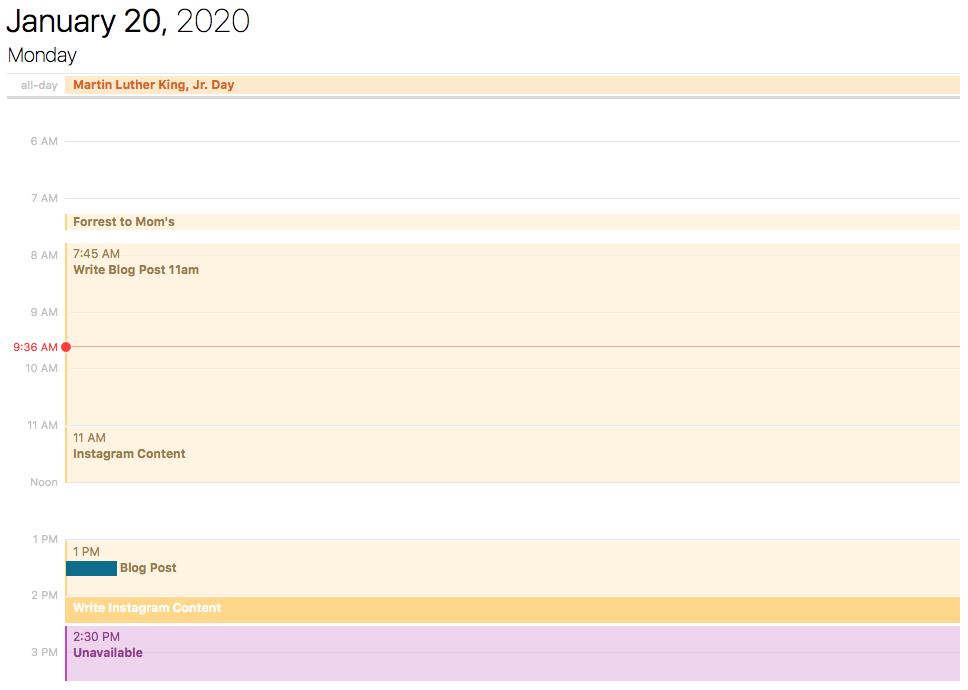
If you have a time estimate for your tasks, it can be really easy to put them on your calendar in blocked out periods of time. This way, your phone can also send you reminders 15 minutes before the block starts—so you can know it’s time to move on to the next thing (or get started on your work day).

I recently started doing this and let me tell you, it’s been a huge help. It gives me a good idea of how my day will look, while also letting me develop a concrete plan for what I’m doing day-to-day. I usually spend 15 minutes the evening before blocking out tasks on my calendar to give me a good idea of what my day will look like.

Here’s an example of what my time blocking looks like today.

Time Blocking Calendar Example

One important note: if you commute, or have appointments that require drive time, make sure to schedule that time in as well.

Doing this can help you develop the habit of seeing where your time is really going. As well, it can help you better estimate how long each task will take over time, so you can become more efficient as well. I schedule several hours for each blog post, as I often need to stop and research as I write, plus I usually do a read through and edit before scheduling.

3. Think of Tasks as Rock vs. Sand

I recently came across a method of organizing tasks known as Rock vs. Sand. Basically, think of small tasks as sand and big tasks as rocks, and then, think of your day as a jar. If you try to fill the jar with just sand (all those little tasks that have piled up or low priority tasks), you’ll never fill up the jar; you’ll feel like you’re just spinning your wheels and you’ll get tired, burnt out, distracted, irritable… but if you fill your jar with rocks first (that is, if you tackle those big tasks that have been on your plate but feel overwhelming or tasks that are high priority), you’ll fill the jar much faster and have time to add sand tasks on top.

Every evening, I sort my weekly tasks into rock tasks and sand tasks. Then, I pick 2 big tasks (writing a blog post, finishing a client project) and a handful of small tasks (taking photos for Instagram, vacuuming the stairs, starting laundry) to accomplish each day to “fill my jar.” That helps me get a better idea of how to block out my time as well. You won’t get burnt out if you vary the amount of effort each tasks takes throughout the day.

Bonus habit: schedule in time for yourself!

My calendar scheduling ends at 3pm, you might notice, as that’s when Forrest comes home from school. At that time, I start cooking dinner, play with Forrest, listen to music, watch TV, catch up on my podcasts, read… whatever. Throughout the day, I try to take short 10-minute breaks, usually to do some step aerobics in the living room while I listen to a podcast or to grab a drink or a snack, but I don’t schedule those. I go by how I’m feeling. But one thing I make sure to do is not schedule out my whole day. At a certain time, I have to switch off and go into mom mode or, ideally, Michelle mode where I’m no longer an employee.

When it comes to improving your time management habits not letting yourself get exhausted and burnt out is a high priority. It’s ok to take breaks! You don’t have to be scheduled and working 24/7.

Do you have any tips for time management?

5 Quotes About Goals to Keep You Motivated All Year

5 Quotes About Goals to Keep You Motivated All Year | Writing Between Pauses

Setting, and keeping, goals has been one of the biggest challenges I’ve had for the last few years. As I’ve written before, my confidence has taken a knock a few times in the last decade and it’s been a fight and a struggle to get back to where I was previously… almost over and over again!

But I find setting goals, and tasks for myself based on those goals, very cathartic and healing in a lot of ways. It keeps me focused on moving forward day-to-day instead of continually thinking about whatever it is that’s happened (being laid off, getting a rejection for a job I wanted badly, whatever).

I know for many people, setting and keeping goals is a struggle. Trust me when I say: me too. I love setting goals, but it’s easy to lose track of them day-to-day. I have a whole post about setting goals that are realistic for you and your life, while keeping an eye on timeliness, here.

However, I also wanted to share a few quotes that I’ve found particularly helpful in my goal setting and keeping my mindset positive and future-focused. I hope you love them! Don’t forget to Pin them if you find them particularly helpful.

Vince Lombardi quote goal setting
 
Earl Nightingale quote goals
 
anonymous quote about setting goals
 
David Duchemin quote about time and being intentional
 
Richard Branson quote about dreams

I’m a quote collector (I have notebooks full of them!). If you find posts like this helpful or fun, please let me know and I’ll add more of them to my calendar. Happy Wednesday!

10 Ideas To Promote Your Blog In Your Instagram Story

10 Ideas To Promote Your Blog In Your Instagram Story | Writing Between Pauses

Here’s a question I see a lot from my fellow bloggers, as well as from small business owners: how do I authentically promote my blog posts in my Instagram story?

Good question.

But there’s a second part: I don’t want to seem desperate or spammy.

Oof. Big oof.

Here’s the thing: if you’re not a natural salesperson (and trust me when I say, I am not), it can be challenging to promote yourself without feeling, well, unnatural. But a huge part of this is your mindset. The truth is, the best and brightest stars are promoting themselves constantly. Lizzo isn’t releasing a new song on Spotify and then, sitting back and not posting about it, worried that people will think she’s being braggy if she asks people to go listen. And while we aren’t all Lizzo, we should all feel like Lizzo: you wrote something you love, you put it out into the world, and you want to share it.

So share it!!

You aren’t desperate for promoting the content you work hard on; you aren’t being spammy for asking people to take 5 minutes to read something. Some won’t, but some will. Repeat after me: I am worthy of success.

That’s the first bit of advice I want to give you about promoting your blog. The second bit of advice is that there are creative, fun ways you can promote your content in your Instagram story. Here are 10 of them.

1. Ask A Question

This is a big of a run up promotion. A long game, if you will. Say you’ve got an idea for your blog. As a random example, let’s say it’s 10 ways to wear a pleated skirt blog post. You might post a question, 3-4 days before your blog post goes live, asking: “How would you style a long, pleated skirt?” As your audience answers the question, you can pull photos that you plan to use in your blog post to show these answers, or simply respond. You can always screenshot your stories as you post answers and use those in the post itself.

Then, when your blog post goes live, you can post a story that says something like: “Remember when I asked how to style a pleated skirt!? I have a blog post featuring some of the top answers, as well as a few new suggestions. #linkinbio.” Simple, easy, you’ve engaged your audience, and given them the possibility of a shout out. A win win.

2. Provide a Sneak Peek

Asking that question is like a sneak peek into your creative process, but there are other ways to do this. For example, you might post a photo of your laptop as you write, with a sneak peek of the topic; or, you might post a few slightly blurry photos for an upcoming topic. There are lots of way to provide a steady stream of sneak peeks into your creative process, such as highlighting your editorial calendar, new products, or purchases and PR. Doing so, and saying, “this blog post will go live in X days!” keeps your audience excited and on the edge of their seats for that new content.

3. Poll Your Audience

Here’s a great way to engage your audience and help them feel like they’re part of your creative process.

  • Draft two blog posts.

  • In your Story, post a poll asking your audience: “this week, would you rather have a blog post on [topic 1] or [topic 2}?”

  • Whichever option wins after 24 hours, post it.

  • Screenshot the poll with results and post a story when the post goes live, and say, “You voted! It’s live! #linkinbio”

So easy! And again, giving your audience a view into your creative process is always a win. You can also include a note that the other topic will go live next week or in “x” days.

4. Create Related Content

Let’s go back to the example in the first tip. Your blog post about how to style a long, pleated skirt goes live. You create a series of Instagram stories that highlight a few pieces of content that you couldn’t include—because of space or simply not being related enough. For example, you might post a series of Stories about “graphic tops that go great with pleated skirts” or “5 boots for spring you should pair with a pleated skirt.” Thing: content that is related, but not directly from the blog post itself.

5. Talk It Out

That’s right: do the scary thing, turn that camera around, and talk about your new blog post. Why did you write it? What sparked the idea? What do you hope your readers learn? Don’t forget the swipe up feature if you have 10,000 followers (lucky you!) and don’t forget to use hashtags & geotagging for maximum exposure.

6. Start the Story

Every blog post starts with a story, something that sparked you wanting to write. Maybe it’s a client question (like this blog post!), something that has been bothering you for a while. Start telling the story of why you wrote your blog post… and then, tell your audience that the story is finished up in the blog post itself. That’s right: get them hooked, then send them on to the next piece of content!

7. Post a Snippet

Pull a few great quotes from your blog post and create some beautiful Instagram story slides. These grab your audience’s attention and make them want to read the rest of the blog post.

8. Use a Theme

Keeping your Instagram stories aesthetic and beautiful for promoting your blog post will keep your voice & brand consistent. Your audience will know what to expect! Use a specific theme for each category of blog post so your audience is alerted when content is most fitting for their interests.

9. Share Topical Posts

You don’t always have to be sharing your newest content. Revisiting older content when its relevant can keep your blog posts evergreen and refresh older topics. For example, you might share older posts when they become topically important. For example, let’s say you wrote a blog post on styling graphic t-shirts a year ago; you might post a story about how you’ve seen so many great graphic Ts available and your blog post is more topical than ever. Then, share the link in your bio or a swipe up.

10. Share Feedback

Getting great comments on a blog post? Or a thread on Twitter about your blog post? Share it to your stories with “Join the conversation!”