5 Tips for Marketing Your Brand During a Pandemic

5 Tips for Marketing Your Brand During a Pandemic | Writing Between Pauses

I’m going to tell you a small annoyance I have: a lot of the women I follow who own businesses have tried to use the current social climate as an opportunity to sell more. To pivot their businesses, or increase their revenue. Here’s the thing: we’re all scared. We’re all nervous about what comes next because we simply don’t know.

One thing I always tell my clients is: you should never take advantage of certain situations to make sales. You can use a tragedy or a societal event to make sales. You can let those things guide your content. But that’s it.

To best illustrate this, here’s an example from back when I worked at an agency: after the devastating fires in California, one of our clients wanted to place targeted ads for their luxury products in the areas most effected by the fires. Their logic was that people needed a place to live, why not buy one of their products to live in?! I remember reading the emails, listening to the conversation, and thinking, “I don’t know how to make people have a heart.”

It goes without saying: we did not comply with their request. We recommended a few other options—such as gathering donations for those effected and driving them to the area, or donating a significant portion of sales percentages—and they didn’t like them. They wanted to make sales, period, on the backs of people who had lost everything they owned.

Friends, I can’t tell you how much this made me want to quit marketing. I think there are lots of misconceptions about marketing, but the one thing that is, occasionally, true is that some businesses will do anything to make money. The good thing is that many marketing agencies refuse to be as cutthroat as these businesses anymore: most agencies have high morals and a specific outlook on how to treat consumers. But battling with clients takes a lot of energy and clout.

I’ve been asked a lot lately about how businesses can best market their products right now. What is the right thing to do? What is the kind thing to do? How can you keep your business afloat and support your community and still participate in marketing so you don’t lose momentum?

Here’s a breakdown of what I’ve been telling my clients.

1. Use Common Sense.

It goes without saying, but: if it feels gross or wrong to do it, it probably is. Posting something that just doesn’t feel right… you probably already know it’s not right. Something that takes advantage of people’s fear (such as posting ads for masks or claiming products help or prevent COVID 19), or something that preys on people’s fears or insecurities… these aren’t good marketing practices even in the best of times.

In general, there are two rules here:

  • Don’t post anything that can harm people. Will your marketing cause harm? Will it make people do something stupid (like rush out to buy something they do not need) out of fear or because they think what you said was true?

  • Don’t make false claims. Right now, there is a lot of information out there on “this prevents COVID 19” or “this will keep you healthy.” The truth is there is no product you can buy and consume that will prevent you from getting COVID 19, so making claims otherwise is bullshit.

2. Chill Out on Heavy Sales.

Heavy sales-focused posts are going to rub most consumers wrong—and all marketers. I have been screenshotting ads that I feel are in poor taste. One I got recently was for a brand I love (I buy their products at Whole Foods all the time) and it was a special sale code using “COVID 19” or “STAY AT HOME” for a certain amount off. Big oof.

There is nothing wrong with advertising a sale right now. But make sure what you’re advertising is appropriate for the situation and you do so with care and kindness towards your community.

Here’s a good example:

  • “We know many of us are at home, which is an incredible privilege. Right now, we are offering a sale on our X product; use code SUNDAY to get 10% off—and we’ll donate 10% of proceeds to [charity].”

Recognize and acknowledge that people might be struggling right now, especially financially.

3. Focus on Compassion.

Related to my last point: a lot of people are struggling now. Some mentally, some financially, some physically. People are ill. People are grieving.

Show some compassion.

If this means pivoting your content away from selling and more towards supporting your community (“what can I do for you? how can I help you? what charities should I donate to?”), then do it. If you have the ability, do it! It’s easy right now to be entirely focused on you and your business. We’re all worried, like I said. There is no point in trying to participate in the “worry Olympics” or trying to make hard times a competition. Yes, some people have it worse. We’re all struggling, though, and being kind of people is pretty much free.

Show some compassion to your customers. Send free product if you can. Cut people some slack.

4. We Don’t Need Another Work from Home Article.

Ok, I’m fully guilty of writing my own work from home article. But if I see one more huge brand posting their work from home tips, I’m going to scream.

After all, it was barely 6 months ago when a business in Eugene told me that they didn’t foresee a world where it was possible for people in my career to work 100% remotely and that asking to work from home so I could more effectively take care of my child was unrealistic. Who is laughing now, friends!? So yes, it sucks to see that very same business churning out work from home content, taking care of your children content, etc. It’s just frustrating for those of us who know that at least some of these businesses have not effectively supported the women or men in their employ who need the ability to work from home, either due to children, commute issues, or disabilities.

So, in short: we don’t need any more work from home content. We just need compassion, support, and a good laugh.

5. Think On Your Feet.

Things are changing every single day. Being able to pivot your content on a moment’s notice is going to be important. For many brands, the ability to stop their content right at the beginning of March was challenging, but it’s taught us one thing: as much as social media managers (like me!) like to have content planned and scheduled months in advance… the reality is that’s probably not an effective strategy in a world where things can change in a moment’s notice.

This also applies to replying to consumer complaints; being able to take on your followers (customers, fans, however you refer to them!) challenges and issues will be part of your strategy from here on out. Seeing a ton of the same complaint? The same issue? How can you help? Can you think of a meaningful response on the spot?


I hope these tips help you market your brand in an uneasy time! Have additional suggestions or ideas? Let me know in the comments

Is it Too Early to Introduce Journaling to my Kids?

Is it Too Early to Introduce Journaling to my Kids? | Writing Between Pauses

I’ll be the first to tell you: staying home all day with kids, with no break, and trying to keep them a) entertained, b) educationally stimulated, and c) emotionally taken care of is a challenge. When I had Forrest, I didn’t think that in 4 1/2 years I would be handed the absolute weirdest historical event to raise him in.

The other day, I was talking to my mother (on the phone, of course) about how hard it has been lately to get everything done and take care of Forrest. I usually don’t struggle with this day-to-day… but without preschool, without childcare, and without Danny now that he’s gone back to school, everything falls on me.

I don’t want Forrest’s first memories to be of this time, to be quite honest, but unfortunately it’s not up to me at this point; and I definitely don’t want his first memories to be of me losing my patience with him because I need to finish writing copy for a client. (As important as that copy is!)

As I’ve written, I’ve been working on developing some preschool activities for Forrest. I won’t say I’m homeschooling—it’s definitely not that strenuous, but I’m doing my best! He has always been a child that needs constant mental stimulation; he’s very good at playing independently, but it’s extremely curious and wants to ask questions and learn all the time. It’s one of my favorite things about him! But as a non-educator, it’s definitely a challenge for me as it’s definitely not my personality type. (You can read about how I’ve organized our daily schedule here! I have made some changes to this, so I’ll be writing an updated version soon.)

One thing I’ve started trying to incorporate daily is journaling. It got me thinking: when is it the right time to introduce journaling? I love journaling (you can read all my posts about it here) and it’s something I want Forrest to love too. It’s an incredibly valuable way to destress, record your memories, and focus on good memories—letting the others fall to the wayside.

Here’s what I learned through researching:

  • It’s never too early to introduce writing skills. At 4, Forrest can write his name and write some simple words. He very badly wants to be able to write notes! This felt like the perfect time to help him work on his early writing skills. We’ve been doing lots of letter tracing, practicing with pencils, and more. A lot of learning to write is learning to hold a pencil and creating those muscle memories and groups.

  • Keep it age appropriate. Your 5-year-old isn’t going to sit down and write a thoughtful journal entry. Keep it to writing about one event during the day and how they felt.

  • Don’t take it too seriously. If it becomes frustrating, put it away for both of you.

  • The benefits are numerous. Journaling, and learning to write early, has a lot of benefits: better communication skills, better writing and reading skills, and an opportunity to work through big emotions.

There doesn’t seem to be an age limit to introducing journaling!

Introducing Journaling to a 4-Year-Old

Did it go well at first? Not really. Forrest was a little perplexed by the exercise, but he’s come around. As I said, he really wants to write. Badly. He wants to be able to write notes, to read, to satisfy his curiosity. Journaling will be a very positive thing for him once he gets a bit better at writing.

We started with supplies.

I ordered Forrest a primary school notebook to start journaling in. It’s a a basic primary school notebook: the top half of the page is blank (for drawing a picture) and then has primary lining on the second half to write a description or journal entry. (There is also a space at the top to write the date!) Every day, I’ve been having him draw a picture about something he did during the day. The first day, he drew a picture of himself dancing. The second day, a picture of the apple crisp we baked. Then, I helped him write a sentence about it, as well as the day’s date. Usually, this is us sounding out words and writing letters.

To help him write, I also got him some basic pencils and some pencil grippers. The pencil grippers are triangular (I’m sure everyone reading this remembers them! I used them for years) and help new writers learn to hold a pencil. Plus, it widens the part they are gripping and makes it easier for little hands. I was going to order some of the thicker kindergarten pencils, but Danny encouraged me not to; it’s better for Forrest to learn to hold a thinner pencil correctly.

If you’ve got a 4-5 year old, these are all cheap supplies you can get just about anywhere and make writing easier.

We try to journal right after dinner or during quiet time. I want to teach him that it’s a good way to wind down in the evening, take a break, and think through the day. He sees me journal a lot and I’m hoping this becomes a habit that is easy for him to keep! Plus, it will be fun to look back on these journal entries later. During a quarantine, his memories are a mix of things we did and random things (like dancing, playing with his Superman toys, or taking a nap on the couch).

Now, it’s your turn: are you considering introducing journaling to your kids? What’s holding you back?

Disclaimer: This post does contain Amazon Affiliate links.

What My Self-Care Routine Looks Like Right Now

What My Self-Care Routine Looks Like Right Now | Writing Between Pauses

“I think I’ve been waiting for this my entire life,” I told my therapist almost two weeks ago.

I’m always waiting for the disaster a little bit. For the bad thing to happen. At every single job I’ve ever had, I’ve waited to be fired. “One day,” I would tell everyone, “they’ll just notice that I don’t know what I’m doing and they’ll fire me.” I’m always waiting for the big snowstorm, the power outage, the car accident. I’m always waiting for something to go wrong somehow. I await chaos at every moment—so when chaos erupts, I actually feel really calm and collected. I stop panicking.

I experienced this after I got laid off in July. I remember telling my therapist how energized I felt, how it felt like I’d been waiting for the shoe to drop for years. We talked then about what this meant, how to prepare for the inevitable comedown.

When I went to my therapist appointment two weeks ago on Wednesday, freshly sanitizing and ready to stay 6 feet away from my therapist, I again felt more calm than I had in ages. We talked about the same thing then: right now, I feel calm because this feels like something I was prepared for… but eventually, it going to wear off.

I’m not saying this to say, “look at me! I was prepared!” I wasn’t totally prepared. While I’m always on the edge of my seat, waiting for the big bad… I didn’t think it would be this. I’m not happy about it. That’s for sure.

I left my last therapy appointment having no idea when I’ll be able to go back to therapy. However, my therapist offered to do virtual or phone sessions, so that’s good to know. At the time, we just didn’t know what would stay open and essential and what wouldn’t. I instead left with a plan to establish a really strict self-care routine that would hopefully carry me through this weeks and prepare me for the ultimate moment when staying home 24/7 with two other people would become too much.

It seems like it might be helpful to share what I’m doing and how I’m keeping my routine in place. I even made a handy printable for you, if you want to start putting a self-care routine in place.

self care during covid19 quarantine


Self-Care versus Self-Soothing

I’m obviously not a mental health professional. However, my therapist has always divided my self-care routine into two separate spheres: self-care (that is, regimented things that help me to improve my mental health and create boundaries) and self-soothing (that is, activities that make me feel better on bad days.

Here are some examples. For me, a self-care item is: is keeping a routine for my day (wake up, make coffee, write in my journal for 20 minutes). A self-soothing item is: doing an Aztec clay face mask at the end of the day.

Does that make sense? Good. Let’s jump into how I structure my routine.

My Self-Care Routine

My routine is ultimately ruled by Forrest’s routine. I knew I was going to have to give him some structure immediately. When Oregon schools announced they were closed until March 31, and then, April 28, I knew that in order to survive, he needed a schedule.

I drew something up that day. It looks something like this:

  • 7:30am - wake up, get dressed, go through what day it is

  • 8:00am - breakfast

  • 8:30am - TV time (Let’s Go Luna and Daniel Tiger on TV)

  • 10:00am - Lesson 1

  • 10:15am - Lesson 2

  • 10:30am - Quiet Play Time

  • 11:30am - Lunch

  • 12:00pm - Outside time

  • 1:30pm - Lesson 3

  • 1:45pm - Lesson 4

  • 2:00pm - Quiet Play Time

  • 3:30pm - Help mom with dinner

  • 4:30pm - Dinner time

  • 5:30pm - Family time

  • 6:30pm - Quiet Play Time

  • 8:00pm - Bedtime

That’s just the morning. Here’s how my schedule fits in:

  • 6:00am - I wake up, get dressed, wash my face, make coffee, journal, and then work until Forrest wakes up

  • 7:30am - wake up, get dressed, go through what day it is

  • 8:00am - breakfast

  • 8:30am - TV time (Let’s Go Luna and Daniel Tiger on TV)

  • During TV time, I catch up on work and do any chores, such as washing dishes or putting dinner in the crock pot.

  • 10:00am - Lesson 1

  • 10:15am - Lesson 2

  • 10:30am - Quiet Play Time

  • During quiet time, I usually try to either take a shower, work, or catch up on laundry/chores.

  • 11:30am - Lunch

  • 12:00pm - Outside time. We usually go on an hour+ walk or hike; this is good for me too!

  • 1:30pm - Lesson 3

  • 1:45pm - Lesson 4

  • 2:00pm - Quiet Play Time

  • During Quiet Play Time, I work.

  • 3:30pm - Help mom with dinner

  • 4:30pm - Dinner time

  • 5:30pm - Family time

  • 6:30pm - Quiet Play Time

  • This is self-soothing time. I usually lie in bed and play Animal Crossing, read a book, do a face mask, whatever.

  • 8:00pm - Bedtime

  • After bedtime, I usually go through my to do list and see what I missed, transfer it to the next day, and make a game plan for what to hit during the day. I try to be in bed by 10pm, but sometimes that stretches to 11 or so.

Whew! I know that’s a lot of information. But I want to show you how my day fits into the schedule I’ve created for Forrest. His lessons aren’t full lessons; we usually read a book and do a worksheet or activity, paint a picture, or learn a song. (You can learn more about the resources I used for these lesson plans here.)

I try to hit a few big self-care routine pieces everyday:

  • Having a routine immediately upon waking up that helps me feel energized.

  • Giving myself time to work and get chores done as I need to (those quiet play times have helped a lot! Forrest’s room is a mess, but who cares).

  • Taking at least an hour for myself in the evening to just relax and do something I really enjoy.

I know for many people, the idea of doing this with kids seems super challenging. Here’s the truth: Forrest interrupts me a lot. But we’ve been talking to him lately about a few things:

  • When a door is closed, you knock and ask if it’s ok to come in. if the answer is no, then the answer is no.

  • When I’m working, I need to work. The less interruptions, the sooner I can make an egg carton tree with him.

During this time, it’s all about survival. It’s ok if a schedule like this won’t work for you. I want you to have the tools you need to create a routine that works for you and if my routine helps you, then that’s great. If not, that’s ok too! However, if you are working from home for the first time, it is important to establish boundaries, if you have kids or a partner, that will help you get your work done and not feel totally overwhelmed. If you need work from home tips, here are mine.

I have also been trying to work in time to meditate each day—or at least sit, without a screen in front of me or a book or my journal or something, and just think and breathe. I really like this guide to beginning meditation.

I also created a handy-dandy printable for you to outline your own self-routine schedule. This is formatted by a checklist and includes a gratitude section; you can use it for daily journaling or just as a one-off. However you use it, I’d love to see it! You can use the hashtag #thisweeksgoldstar on Instagram.

Download Now

I hope it helps you! I’m always here to chat. This is a tough time, but if we lean on each other, we’ll all be held up. Stay safe, stay home, and stay healthy!

Working from Home? Here Are My Top 4 Tips for Staying Productive

Working from Home? Here Are My Top 4 Tips for Staying Productive | Writing Between Pauses

As we all work on social distancing to prevent a massive influx of those infected with COVID19, many jobs have moved to entirely remote positions. You might be one of those people: you’ve typically worked in office-only jobs, where you left everyday at the same time and knew what was expected.

First things first, working from home, especially right now with many people furloughed or laid off, is a huge privilege. I think we all know that!

It’s ok if you’re nervous about it too. It’s ok if you aren’t sure if you’ll like it. And it’s also ok if you know right now you don’t like it at all. That’s ok!

If you’re new to the working from home game, I want to help. Right now, there are so few things we can all do to help others and, as a fellow slightly displaced, a little confused worker, I want to help where I can. If there is one thing I know, it’s working from home! I am hoping that sharing a few tips for working from home will help at least once person.

If you want more posts about being productive while working from home, here are two of my favorites:

*Consider yourself an honorary freelancer now!

Now, let’s get to those tips.

1. Take Care of Yourself.

I want to tackle this one first because I think it’s the most important one. We are all going through something that is, quite honestly, very traumatic. Our lives are being completely turned upside down. We all have family and friends who are suddenly out of work. We all have immunocompromised, immunosuppressed, or at-risk family members and friends. Things are very stressful and it will be natural to have that stress keep up.

So most importantly, take care of yourself in whatever way you can. I highly recommend getting a self-care routine in place right from the get go. Why? Because the sooner you have that routine in place, the easier it will be to maintain when things get hard.

I always tell people there are two pieces of self-care: the actual self-care aspect (what you need to do to keep your mental health good) and self-soothing techniques. Here’s how they differentiate:

  • Self care is: going to therapy; taking your medication; practicing deep breathing to slow your heart rate during a panic attack.

  • Self-soothing is: taking a bubble bath; using a lotion that smells good and calms you down; turning the news off when you’re overwhelmed.

Spot the difference? I think for many, this makes it easier to understand. Your self-care routine should be a mix of all of these things. Now might be the time to sign up for Talkspace so you have access to a mental health professional. Or, if you already attend therapy, get your meetings arranged to be over Zoom or Skype now. Then, start thinking of self-soothing pieces you want. Do you want to set aside 40 minutes every evening for a bath? Schedule it in, babe!

2. Set Strict Work Hours.

I keep a work calendar for everyone I work with and I block out my work hours on every single one. If you text me outside of those work hours, or your email me on the weekend, I will not respond to you. Period. End of story. I used to be not so strict about those, but once Oregon implemented a stay-at-home order, I decided to be strict about it.

I like working. But I don’t like feeling overwhelmed by work.

So, my advice is this: make your work hours known and stick to them. Don’t let anyone talk you out of them. Not your boss. Not your coworkers. Not your partner who is inexplicably on a work call at 8pm. Don’t let them down it! Stick to your hours. Strictly. If you do decide to be loosy-goosy and start early, don’t work over 8 hours. You’re going to burn out; you’re going to get tired; you’re going to get overwhelmed and frustrated and stressed. Be kind to yourself. Set your work hours!!!

3. Designate a Work Space.

You might not have the space for an office. Trust me, I get it. My office used to be a landing on my stairwell. It was tiny and uncomfortable and I hated it in a lot of ways.

Even if you don’t have an office in your home or apartment, you can designate a space where The Work Happens. This might be your kitchen table, which has a nice plug. You might have a desk in your bedroom that works and has a window you can look out. Whatever works for you. Pick a work space and stick with it.

Just like setting your work hours, I want you to be strict about this with yourself. Here’s why:

  • You have to maintain good posture and ergonomic working conditions. Why? Because this will vastly impact how you feel physically. Working on the couch sounds great until your back aches.

  • You have a designated space where The Work Happens and when you are in that space, you work. When you are not in that space, you do not work. This is a big thing mentally. It will help you be more productive. I promise.

4. Practice Breaks.

Working from home means there are less interruptions. No coworkers stopping to chat for 15 or 20 minutes. No quick breaks to the bathroom where you end up joining a lively discussion about a TV show. No quick brainstorms. Everything is scheduled out.

That means you get less breaks, mentally. So, schedule breaks into your day. Take 10 minutes to call a friend or talk to your partner. Or take your dog for a walk. Make yourself a snack or a cup of coffee. Do something other than work for a few minutes, then get back to it. Breaking up the day will help you stay on task longer and not feel so burnt out and tired.


There you have it! Those things might feel pretty basic, but as these days pass, I want you to focus on them and make sure to set and keep plenty of boundaries. Bringing your work into your home can be a great way to save money on gas and protect people from COVID19. But it can also be very stressful and overwhelming.

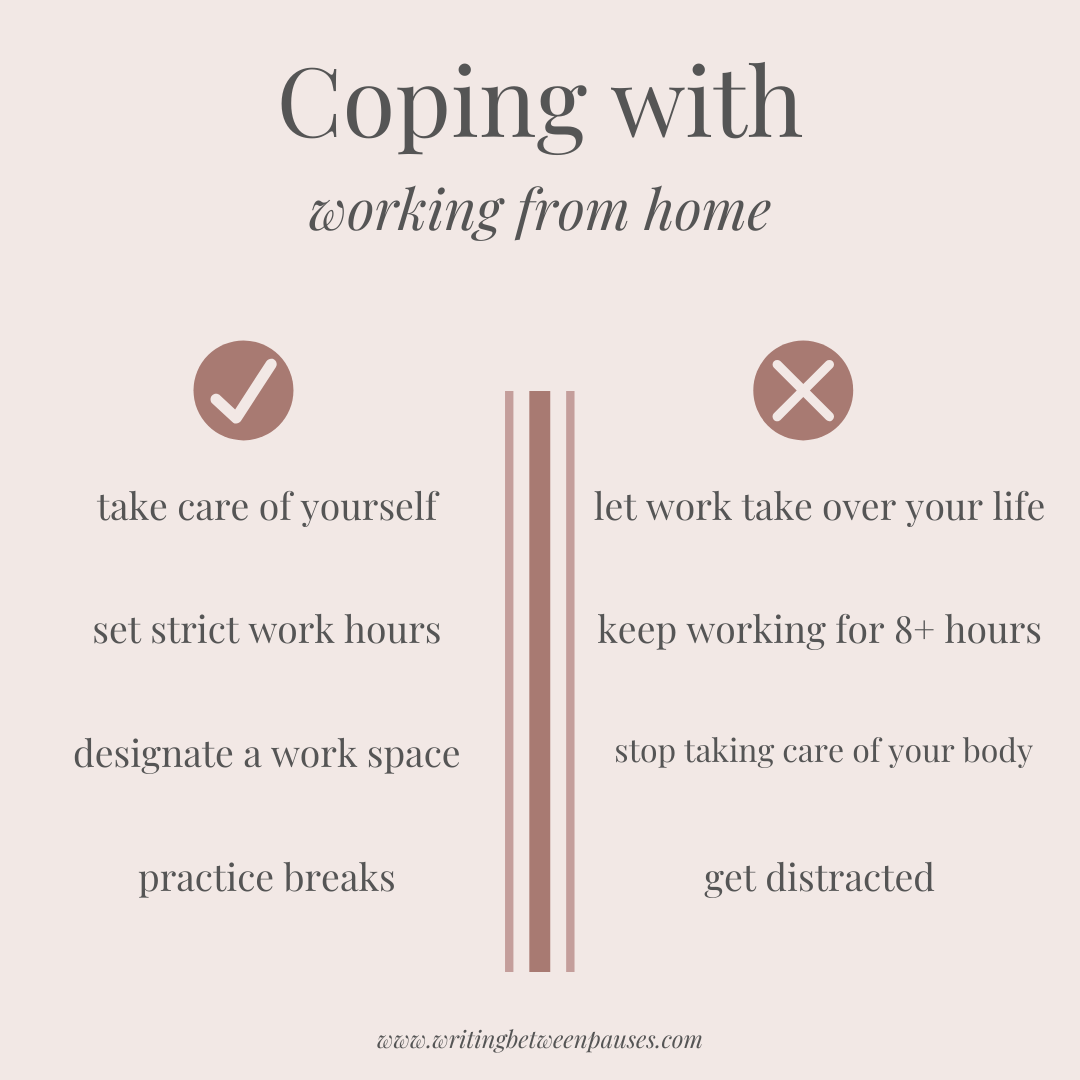
Here is a handy dandy graphic that breaks down the do’s and don’ts of working from home.

How do I cope with working from home quarantine social distancing covid19

Life Lately: 5 Things I Learned This Month

Life Lately: 5 Lessons I've Learned This Month | Writing Between Pauses

Oh hey, long time no see!

I first started this blog post on March 11. I’ve deleted and rewritten the whole thing at least 3 times. It’s really hard to put into words how our lives have all changed since then, right? Originally, I wanted this blog post to be a write up about where I’ve been and what I’ve been doing—a sort of call back to the old days of blog posts when things were more personal, less “evergreen”.

Not only has the last month felt like the fastest and longest of my life, I feel like our world has pretty much completely changed. Will things be any different after this? Or will everything be different?

I posted this on Twitter, but I really do think the first boom of bloggers in 2009-2011 was in part caused by the recession in 2008-2009. I know for me, I started blogging from my dorm room in 2009 when shit was going absolutely to hell in the “real world.” When I graduated in 2011, I couldn’t find a job—so I threw myself into blogging, it became part of my identity, and boom! Became part of my career, in many ways.

I wonder how this—that is, what is happening now, alongside the economic impacts—will change blogging in the future. I’ll admit to being incredibly frustrated by the rise of influencers; it’s made having my own blog more complicated, as I feel like I have to compete to work with brands who would prefer a ton of followers over genuine readership. (This isn’t a brag; my blog gets a significant amount of traffic, but God, do I hate Instagram.)

This is all to say one thing: in February, when I started a new temp job, I made the decision to step away from my blog for a little while to decide what to do.

The truth is that I love blogging. When I was laid off in July, I thought blogging might be a key to being part of my career. But the more I’ve tried to make this blog part of my career, the more miserable I have felt about the whole thing. I like writing about whatever I want to write about. I want to review make up again. I want to write about whatever I want again. I don’t want to have to worry about discount codes and monetization and promoting. I just want to write.

That was a lot of what I wanted to say when I started this blog post. Then… COVID19 happened. What can I write that hasn’t already been written?

The last month of my life has really flown by. For a lot of reasons! I often find when writing these life update posts, it’s best to structure things in “what I’ve learned.” So, let’s chat, shall we? Here’s everything I’ve learned in the last month.

1. Always be prepared.

My husband, Danny, has a relative that everyone makes fun of for saving everything. She saves Cool Whip containers and the remnants of every meal, no matter how small. To them, this was sort of a begrudging tendency towards penny pinching, caused by growing up in the midwest during the Depression.

Do you wonder what effect this quarantine will have on us? On our children?

Will I ever let us go without having a small stockpile of toilet paper, laundry soap, and hand soap ever again? Will I pay more attention to have nonperishables in my pantry? Will Forrest be more conscious of how his health effects those around him? Will he be offended by extreme hoarding?

Just something I’ve been thinking about. But this has made me realize how much more prepared I need to be. When the Governor of Oregon, Kate Brown, announced that schools would be closed until the end of March (and then, April 28), I immediately thought, “oh shit, what are we going to do!?” I didn’t have anything. I had nothing for craft projects. My printer was out of ink. My pantry was looking sparse.

I thought I learned my lesson during the snowstorm of February 2019, when we only had a few gallons of water saved up and we ended up melting snow on our wood stove to flush toilets every day. (It took hours.) Danny and I made a preparedness plan then. But, then, life got in the way. I got laid off. I started freelancing. I gave up on finding a job. We got busy. And we stopped being so prepared. I stopped grabbing a few extra cans of soup or broth when I went to the grocery store.

Anyway, if nothing else, this has taught me: always be prepared. Have hand sanitizer and bleach on hand at all times.

2. Late February was probably not an ideal time to start a new job (or maybe it was?).

That’s an exciting announcement though, isn’t it? I started a temporary job, only supposed to last 3 months or so, in late February. I was supposed to start March 1, as I am covering a woman on maternity leave, but things happen, you know. I started, got used to everything, and then… COVID19 hit.

It was like a wallop to the face, huh?

It’s been great though. If there is one way to show people I’m a great employee, it’s really keeping my head during all this crisis. The team transitioned to working entirely from home—and I was already there, with everything I needed to make it work. It felt good. It feels so good to be part of a team again. I love it so much and I love the work that I’m doing, because I feel like I’m learning a lot about what I do in a different way.

It’s definitely a weird time, at least looking at economic impacts, to be in a very temporary space. That being said: I’ve been a temporary space since July. I’m used to it and I think I will be ok after this. If I can survive everything I went through last summer, I can make it through another uneasy, difficult summer. (I wish I didn’t have to, but there we are!)

3. It’s ok to let go of the routines.

I am a routine driven person. I write about it a lot. I like having a routine. I like feeling like I have control.

But sometimes, the routine is just too much.

When Forrest’s school was shut down (right before Danny’s birthday—sorry Danny!), I immediately started making a schedule for him. I knew for his sanity, and mine, we needed to implement something right off the bat so he would feel safe and secure.

But we also needed to explain why he wasn’t going to school anymore.

This was all a big bummer because Forrest had been struggling with anxiety about school for a few months—which was a bit odd for him, but as a family, we were a bit all over the place in October to January. It’s sad for me and him that once he was more comfortable with school… it was gone. He’s been sad and confused about what’s happening, but at 4, I don’t really want to scare the pants off of him.

I knew he needed a routine. I knew I wanted to keep school going for him in whatever small way I could.

But each day, the routine works up until a certain point. And then it no longer works at all. Usually that point is about 7:30 at night. In my ideal schedule, we would get Forrest ready for bed, snuggle him in, and say night night.

That is not how it works. We’ve ended most days the past two weeks with brushing teeth and then Forrest crawls into bed with me to watch a movie. I know, I know… this is potentially the worst sleep habit. But he’s only 4 and he’ll only be 4 for a little while. I don’t want his memories of this time to be scary or weird or dystopian like mine are. I want him to remembering getting to watch his favorite movies every night before falling asleep with me.

So yeah, the routine is important. But I kind of had to let it go too.

4. Turning off the news is ok.

Every day for work, we do a check-in and one of the things we do is talk about any positive or negative news we’ve heard that others might find interesting. For the first few days of my entire team being at home, we all had a ton of news to share: this state was doing this, or we learned this about the virus. Whatever.

By Thursday, we were all really quiet during that part of the meeting. A lot of us simply couldn’t pay attention to the news as much. It was too overwhelming. Too scary. Too much information in some ways and too much of it was misinformation one way or another. We all had to step away.

it felt really good. I believe in being an informed citizen and right now, it feels a bit like my job to be up-to-date on what’s going on. Comparatively, I’m good at staying up to date on just about everything. But at a certain point, it’s not just collecting information. It’s obsessively trying to stay on top of the situation as a way to calm my anxiety—and thereby, making it worse. Every piece of information I learned, I found myself getting more and more anxious. Being snippy. Being unable to focus on tasks.

I stayed off Twitter over the weekend. I muted related terms on my Twitter feed. I tried to stay off Facebook and Instagram. It felt good. I read. I watched TV. I wrote. It felt good.

So yes, I like to stay informed and I’ll probably start to view a few select sources for COVID19 information. But if you, like me, are very easily overwhelmed by too much information, let me be the one to tell you: you have permission to stop paying attention to the news.

5. I have so many projects to finish.

I have all the time in the world now. No weekend trips. No spring break trip that Danny and I have had planned for months. No going to Target and lunch on the weekends. I can’t even visit my mom! We are at home, doing the responsible thing. We moved into our house in July: 8 long months ago. I have so many projects to finish. Rooms I haven’t painted. Boxes that I still have not unpacked. Closets that are still just stuffed with a mishmash of things. Woof! I guess now is the time. I started a list. I’m check it twice. Don’t judge me.

The 4 Resources I Used for Making Pre-K Lesson Plans

The 4 Resources I Used for Making Pre-K Lesson Plans | Writing Between Pauses

A few days ago, I started writing a life lately post about what I’ve been up to lately. I didn’t mean to stop posting here in mid-February… but I did. The reason is that… I started a temp job at a creative agency, which takes up a majority of my time, plus I finally started picking up a bunch of freelance work… which takes up a lot of my time as well. As a result, blogging fell by the wayside.

And then… covid-19.

I have been going back and forth about how much to say. I think at this point—the world is better off with uneducated people saying less and all of us listening to people who do know what’s going on. That’s my stance, really. Listen to the people who know what they are talking about and do not take advice from random bloggers on the internet in regards to medical information. I think that goes for the rest of the time we’re alive, but especially now.

Very late on Thursday last week, we got news that schools in Oregon would be closed until the end of March. That meant Danny won’t be at work for the next 2 1/2 weeks. Forrest won’t be in school either. And I’ll be working from home on about 60+ hours worth of freelancing and contract work. Great!

How can I make this work?!

Here’s the thing about schools closing: on one hand, I completely understand that social distancing will keep people healthy and safe, and reduce the risk of catching and spreading covid-19; but on the other hand, schools are a stabilizer for many children in my community. And I don’t just mean children who rely on meals at school (although that is a very, very pressing issue); schools help kids feel safe in their routine.

I knew immediately I needed to set up structure in Forrest’s life to make sure we didn’t all lose our minds. And now, three days in, I can tell you I feel pretty good about my choice.

I wanted to share how I designed a schedule for us. It’s nothing strict. I’m not doing full homeschooling; I do not have the education or ability to do that. But having activities and structure is really important for Forrest; I wanted him to have opportunities to learn something new, try an activity, and play, which would also give me time to focus on my work.

First things first, I made a quick daily schedule template that I printed off for every single day. I have a blank version here that you can download for yourself—or you can use it as a starting point to design your own. Forrest and I are both early risers, so that is reflected in our schedule, unfortunately.

Once I had it printed, I started filling in blanks as I was able to, such as meal ideas.

Then, I started looking for educational resources to do at least 2 lessons per day.

What Resources Did I Find for Pre-K Students?

There is a lot out there for preschool, pre-k, and kindergarten, fortunately. (And actually, homeschooling blogs do a lot of good work! I’m honestly really amazed.) I wanted to share the 4 resources I used the most. They are:

  • Scholastic Learn at Home: Scholastic has put together lesson plans for pre-k and kindergarten (as well as other age groups!) that include free access to Book Flix and the Watch & Learn Library. Right now, they only have a weeks worth of lessons up, but they provided a good starting point for me in terms of picking themes. Plus, having access to Book Flix means I have access to a ton of books I can read to Forrest whenever he gets bored. I just log in on my phone and go from there!

  • All Kids Network: I’m a big worksheet fan. You’ll probably be able to tell pretty quickly, but I found it easier to center our activities around a worksheet. It’s cheap and easy and means I don’t have to run to the store for craft supplies that I don’t have. All Kids Network is free to sign up and has a ton of free, printable worksheets. I used a lot of resources from here.

  • 123 Homeschool 4 Me: This was my most used resource! This link is to the entire preschool and pre-k library. I used a ton of their resources, specifically related to spring and holidays. Their Alphabet Search pages are particularly fun and 3 days in, have become Forrest’s favorite thing to do. I just print a few and let him go!

  • Pinterest: It goes without saying that if I’m looking for something, I’m looking on Pinterest. If I had a specific idea for something, I searched for it on Pinterest first. As an example, one of the Scholastic lesson plans uses a book about the moon; I knew Forrest would love that, but I didn’t have stuff for the craft they recommend. I searched “moon pre-k worksheet” and bingo! Found one immediately. Download, print, and done. I started saving all my favorite worksheets in a single board so I can return to them when I need them.

What Else Can I Do?!

I know organizing a schedule like this is not everyone’s bag. But the thing is, if you’re working remotely, structure will help you get your work done and not spend all your time yelling at your kid! Sanity is important. I’m not anti-screen time, but I don’t want Forrest watching the Simpson’s at 3pm every day (because that’s often the only thing on TV!!), you know?

Even if you don’t want to do a full schedule, I do recommend picking a few things to do every day. You don’t have to do specific lesson plans, but you can structure and make each day fun. Here are a few ideas to get started:

  • Plan to spend time outside. You don’t have to go anywhere. But get your kids outside, even if it’s cold. Bundle up in coats and set up some washable paints or sidewalk chalk on the driveway. Or, better yet, do a short nature scavenger hunt. Go for a walk around the block.

  • Pick one or two educational things each day. This will keep your kids brain’s active, as well as their bodies. They’re going to have a TON of energy!! Harness is with some crafts, worksheets, stories, and songs.

  • Plan for quiet play time. I know some kids struggle with this, and I get it. But we set aside one hour in the morning and one hour in the evening for quiet play time. Forrest goes in his room and shuts the door. Thankfully, Danny’s office is right next to Forrest’s room and my office is right below Forrest’s room, so we can track him through sound. He’s gotten better each day about playing independently, giving us both at least two solid hours for phone calls, team check ins, or silent screaming because we miss other human beings.

  • Make it fun. I think a lot of parents have approached this time with dread. And I totally get it. It’s overwhelming; everything is scary; we don’t know how long this is going to last. I think there are ways to make it fun for kids though. We are planning to a “family camp out” in the living room on Friday; we’ve been having Forrest help us with dinner, as well as cleaning up every day. Make things fun for kids, let them use their energy, and, most importantly, use this time to reconnect.

I hope you find these resources helpful! I know it’s a crazy world out there, but stay safe, stay healthy, and help your neighbors.

Book Review: 52 Lists for Calm by Moorea Seal

Book Review: 52 Lists for Calm by Moorea Seal | Writing Between Pauses

I don’t often write book reviews, but when I do, I like it to be something that I really feel matters.

I originally intended to have this post up last Monday, but—surprise! I started a semi-long term job that has kept me pretty busy the last week. My freelance work has also picked up a lot. Needless to say, I’m busy, but I’m trying not to let that toxic busy-ness make me insufferable.

I use a lot of Moorea Seal’s 52 Lists products. Her original 52 Lists book is one of my favorite journals ever; I did it the first time through in the year after I had Forrest and let me tell you, some of those lists really take me back to those harder days. If you’re new to journaling, or just need some inspiration, I cannot recommend it enough.

I use her 52 Lists planner every single day; it’s one of my favorite planner layouts and I’m already planning to purchase it again for next year.

So when I bought 52 Lists for Calm in late December, I knew I was going to enjoy it. I like journaling and I find it very easy—but I often struggle to really write down what is making me anxious, as I always worry it will make me more anxious to write about it. However, I knew I needed a way to work through everything that has been swirling around me since I was laid off back in July. I wanted this book to be that for me.

And thankfully, it does a good job of it!

I’ve written before about how beneficial I find journaling. No matter how you choose to journal, I think it’s beneficial to let yourself have some time to unwind. The primary way I use 52 Lists for Calm has been as a book to keep on my desk to grab whenever I need a few minutes to just write without thinking. Plus, even once you fill in all the pages (and I’ve probably filled in 75%), you can reuse the prompts: in a Google Doc or another journal or even on the Notes app on your phone.

52 Lists for Calm is separated into 4 sections: Being Present; Look Back; Move Forward; and Release. All of the sections have lists that walk you through finding ways to release your worries, really tap into what is bothering you, and release it. List 7, as an example, has you write out everything that is stressing you out—then destroy it, either through burning it, crossing it out, whatever works for you.

It is surprisingly cathartic!

My favorite section is probably the Look Back section. What can I say? I’m a Type 4 Enneagram, I love being introspective and nostalgia is my drug of choice. I loved List 14, which was all about writing out things that brought me comfort in childhood, as well as List 21, which prompted me to list things about myself that I feel scared expressing.

Basically, 52 Lists for Calm walks you through a bunch of different fun, interesting lists that let you peer directly into what calms you down. I think it’s easy to start a guided journal like this with the idea that it might fix your stress—but to me, it was actually more about finding things that I already knew work to help me calm down, see the bigger picture, and stop worrying.

I’m going to keep this review short and sweet: if you’ve been wanting to get into journaling, but find it overwhelming, I think 52 Lists for Calm will be a great place to start. Even if you’re an experienced journaler, I think it’s a great way to find some new prompts and get to writing. No matter what you use it for, I have enjoyed working my way through it. Moorea Seal designs beautiful books (let’s be honest: how it looks is 100% part of the package for me!) and that’s probably why I love them so much.

If you want to test 52 Lists for Calm for yourself, click here to buy a copy!

5 Writing Prompts to Get Your Creativity Flowing Every Day

5 Writing Prompts to Get Your Creativity Flowing Every Day | Writing Between Pauses

The most important part of writing is doing it.

I’m actually not a fan of the old adage that you should write everyday, regardless of how you feel. If that works for you, then gah bless ya, as they save. It actually is something I practice myself—but I recognize that sometimes the amount I write day-to-day isn’t sustainable or healthy, and my desire to write everyday sometimes doesn’t come from having anything to write about, but rather a feeling that I “need to get things done.” There is also, of course, the fact that my writing is what pays my bills at this point.

This is all to say: if you want to write more, but the thought of having to write every single day to take yourself seriously is overwhelming and stops you, please know you don’t have to write literally every day.

It also goes without saying that it isn’t sustainable to try to write all day every single day. Like I said, writing pays my bills—but I’m not writing 8 hours a day.

If you are looking to write more frequently, or even every day, it can be really easy to get writer’s block. But sometimes all you need is to write something once and then the rest starts flowing. I like to do short writing exercises in the morning. I have a few books I pull from: Coffee Break Writing, The Story of My Life, and 52 Lists for Calm are 3 I keep on my desk to pull and work on. After that, I usually feel good enough to head into my work tasks.

I have a few other prompts that I keep on hand for when one of those 3 books just isn’t doing it for me. I thought I’d share my 5 favorites to help you get started in developing a writing habit!

1. Write a List

No, not your to do list (although you should do that too, trust me, if only to get a handle on your time management skills.)

Sometimes, I write a list of whatever I’m thinking about: things I’m thinking about; funny tweets I’ve seen; books I want to read; tv shows I’ve been meaning to watch. Other times, I write more creative lists, like: my favorite flowers & what they look like; my favorite smells; things that remind me of my childhood Christmas; or things in coffee shops that annoy me.

How long I make the list is entirely dependent on how into it I get. Sometimes, they end up quite long. Other times, quite short. Sometimes, writing those lists will inspire me to write something else: a poem about Forrest or a blog post or an Instagram caption. Either way, they’ve done their job. Plus, it’s nice to have a bunch of lists to look back on.

2. Read Something You Love—then Reimagine It

This can be anything: read an article, a poem, a section of a book, a scene in a movie—and write a short reimagining of it. Write The Hunger Games from Gale’s perspective. Rewrite that famous William Carlos Williams poem. Turn Harry Potter into a story about Penelope Clearwater. Take Frankenstein’s monster and put him in Brooklyn, 2020. Whatever you choose, reimagine it as something else entirely—whatever that means to you.

If what I imagine is longer than what I can write in the 30-40 minutes I’ve given myself, I often just write a synopsis or a few bullet points about what would change. Sometimes, I’ll write one short scene of it or a prose poem. If I’m reimagining a poem, I might write it as an Instagram post or a TikTok video. It helps me think differently, make something new out of something very familiar. Be playful. Have fun. This is just for you.

3. Write American Sentences

What are American Sentences you ask? American Sentences were invented by Allen Ginsberg, as a 17-syllable sentence that mimics a haiku. (Haikus follow the 5-7-5 syllable rule; added together, it’s 17 syllables total.) This is a good rundown on American Sentences that has a ton of examples.

American Sentences require you to think carefully about what you’re trying to convey in your writing, as well as the rhythm of the words themselves. To me, it’s very helpful to write this way because it forces me to be more concise and direct. (You may have noticed my tendency towards being verbose. No apologies.) For me, it’s fun to play with language in this way when no one is looking—and it helps me feel more creative. Read some examples and try your hand at writing a few. I think you’ll be surprised!

4. Reread Your Old Writing

Whenever I’m feeling particularly stuck, I go and reread something I’ve written. At least once a year, I reread my former NaNoWriMo novels—and often find myself rewriting parts of them, tweaking the storyline or descriptions. I also will sometimes reread stories I started, but never finished. A prime example is a short story I’m currently working on, that I actually started nearly a year ago; I considered working on it for NaNoWriMo, but couldn’t nail down a plot. I reread it recently and started working on it again—getting an idea for at least 10,000 words.

Sometimes, rereading things we’ve written before will give us new ideas—or at least give us a few minutes of working on something that reenergizes us. This kind of writing specifically is helpful because it works on editing, which is a valuable skill we all need.

5. Write About the Weather

Recently, I started a weather journal. This was partly inspired by Nick Cave, but mostly was just a way for me to journal without putting pressure on myself to actually produce something or write something meaningful. Very often writing about the weather turns into me writing something else—things I want to remember, things I’m doing, what Forrest is up to, how I’m feeling.

Every day, write about the weather as you see it from where you are: what do you see? What do you smell? How did you have to dress that day? What does it remind you of? Describe it. Use all your senses! It doesn’t have to be more than a paragraph or two, but it feels like a lot at the end—and might give you ideas for something else to write about.